
The Ultimate Ukulele Buying Guide
 by Jonas
Buying your first ukulele comes down to four things: size, wood, brand and budget. Here is all four, plus the ukuleles I have played and can honestly recommend.
Four things actually decide which ukulele you end up with: the size, the wood, the brand and your budget. This guide goes through all four, tells you where to buy and what to check the moment it arrives, then lists the ukuleles I have played myself and can recommend in good faith.
Skip to the tested picks if you would rather not read the reasoning.
What ukulele sizes are there?
There are four main sizes, plus the sopranissimo which is smaller still at around 16 inches (40 cm) and has been gaining a following.
| Size | Length | Tuning | Sounds like |
|---|---|---|---|
| Soprano | 21 in / 53 cm | gCEA | The classic bright ukulele sound, 12 to 15 frets |
| Concert | 23 in / 58 cm | gCEA | Same classic voice, a bit louder, more room between frets |
| Tenor | 26 in / 66 cm | gCEA | Deeper and fuller, the pro favorite |
| Baritone | 30 in / 76 cm | DGBE | Deepest of all, close to a nylon-string guitar |
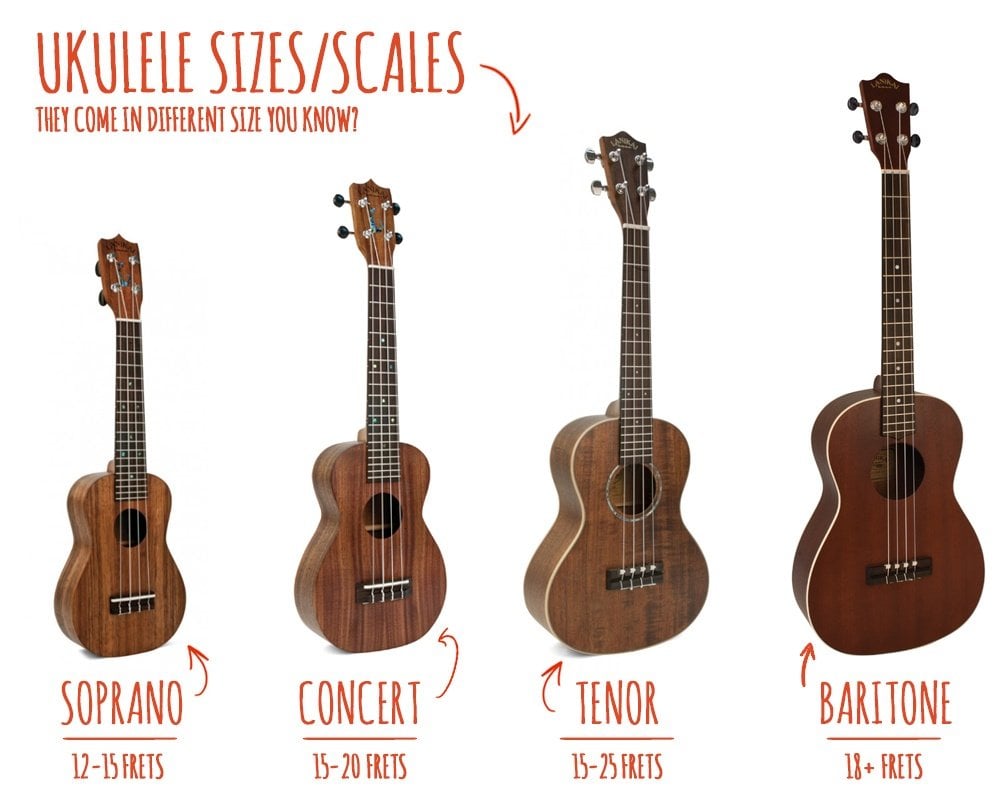
The soprano is the one most people picture when they think ukulele. The concert is a little bigger and easier to handle, which is why I usually point beginners there. The tenor strays towards a classical-guitar depth and is what most professionals play, James Hill among them. The baritone is the outlier: it is tuned differently, sounds guitar-like and is the least popular for exactly the reasons people buy a uke in the first place. My baritone guide makes the case for it anyway.
Want the full side-by-side? I break down how each size sounds and feels plus which one suits which player, in the ukulele sizes guide.
What wood should you pick?
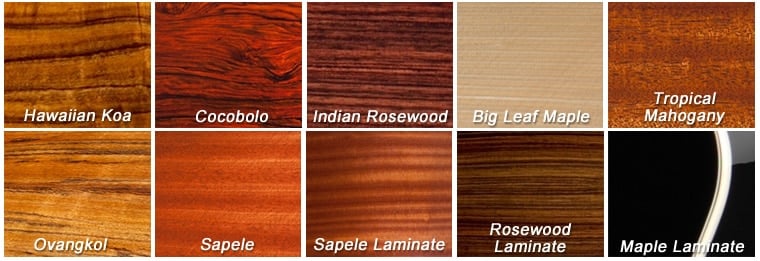
Ukuleles get built from all sorts: monkeypod, mahogany, mango, koa, rosewood, cedar, acacia. Three of them cover most of what you will actually see in a shop.
- Koa is the quintessential Hawaiian wood, so most ukuleles made in Hawaii use it. Beautiful grain, very warm sound, found on the more expensive instruments.
- Mahogany is the mid-range standard. A little softer sounding than koa and quite a bit cheaper, though solid mahogany still costs.
- Spruce turns up on lower-end instruments such as the Mahalos.
Solid or laminated?
Solid means the wood you see on the outside is the wood all the way through. Laminated means cheaper wood inside with a thin layer of nicer wood on the surface, where that outer layer is mostly about looks. A laminate ukulele is more affordable and shrugs off humidity swings better. A solid wood ukulele resonates more and its sound tends to open up as the instrument ages. Neither is wrong, they simply suit different situations and budgets.
Which brand should you choose?
It is genuinely hard to narrow this down, because there are plenty of good makers. The names worth knowing are Kala, Mahalo, Lanikai, Pono, Kamaka, Luna, Cordoba and Kanilea. Pono, Kamaka and Kanilea sit at the higher end. Kala spans the whole range from beginner to serious, makes very decent starter kits and is easy to find almost anywhere, which is why it shows up so often in my picks below.
What I would avoid is the unbranded bargain-bin ukulele. Those are the ones that will not hold their tuning. Nothing kills a new hobby faster.
How much should you spend?
Good ukuleles start around the $100 mark. A sensible beginner budget is roughly $80 to $150. Below that things get unreliable. Anything selling for $30 or less is generally a toy rather than an instrument. If you are serious about playing, skip the $20 to $50 starter sets and begin with a decent $100 uke. It stays in tune, it plays in tune up the neck, it is more fun, so you will pick it up far more often.
Once you go well above that, it becomes hard to find a genuinely bad ukulele. Everything in between is a solid choice.
Where to buy and what to check
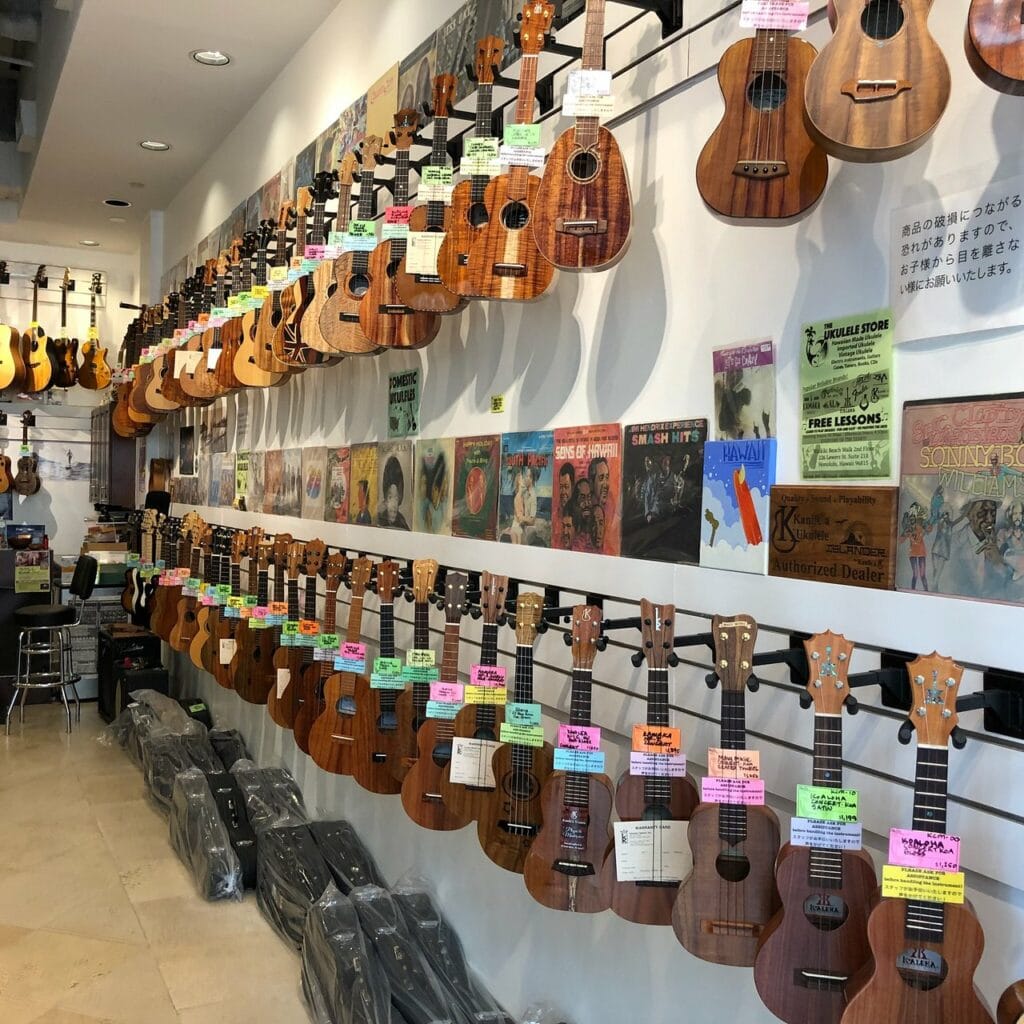
Your average local music shop is not necessarily a good ukulele shop. I happen to live near a great retailer that keeps top-end Kalas in stock, but I have been in plenty of shops that carry nothing but Mahalos in every color of the rainbow, chosen to appeal to as many people as possible rather than to play well. If your local options are thin, buy online. I have had consistently good experiences with TheUkuleleSite, formerly Hawaii Music Supply, who are friendly and ship instruments properly set up. I bought my limited-edition tenor Kala with a solid cedar top and golden acacia back and sides from them and still love it.
One honest warning about ordering cheap online. I have bought a fair few lower-end ukuleles in the $50 range over the years and at least half of them arrived with no setup at all. The usual symptom is that the thing simply will not stay in tune. The usual cause is loose tuning keys. Tightening the little screws on the peg heads fixes it more often than not, so do not panic the moment your new ukulele misbehaves. If it keeps drifting after that, my won’t-stay-in-tune guide works through the other five causes.
Quality strings matter more than you think
If this guide teaches you one thing beyond the budget, let it be this. If a ukulele has black strings that feel plasticky, the sound will disappoint you. Good nylon strings cost about $10 and they transform a cheap instrument. The two best-known brands are Aquila (soprano, concert, tenor, baritone) and D’Addario (soprano, concert, tenor, baritone), both offering good stability, durability and that warm traditional tone. There is more detail in my best ukulele strings guide.
Coming from guitar?
Worth saying plainly: a ukulele is not a small guitar. You generally do not use a plectrum. Two fewer strings will not automatically make everything easier either, since some shapes are actually more awkward. It is a different instrument with its own habits. My ukulele versus guitar guide covers what carries over and what does not, including the baritone, which is tuned like a guitar’s top four strings.
What ukulele to buy, for every budget
Below are ukuleles I have had in my own hands: held, played and properly reviewed. Honestly, good budget ukuleles are hard to find. The ones listed here are the only ones I can recommend in good faith at that end.
Budget picks
- Strong Wind Soprano (absolute budget)
- Kala Makala Waterman Soprano
- Makala MK-S Soprano (Acacia)
- Kala KA-15S Soprano
- Kala LTP-S Soprano starter pack
- Kala KA-C Concert
Step-up picks
- Kala KA-PWT Pacific Walnut Tenor
- Kala KA-BMB-S solid bamboo Soprano
- Kala KA-BMB-C solid bamboo Concert
- Kala KA-BMB-T solid bamboo Tenor
Premium picks
- Kala KA-EBY-TE Striped Ebony Tenor
- Lanikai ACST-S Soprano
- Oscar Schmidt OU6K-A Tenor (koa)
- Ohana TK-50ME (high-end)
Prefer a cheap one that still plays well? My best cheap ukulele guide digs into that end specifically.
Got it home? Do these three things
- Tune it. A new ukulele will be badly out of tune and its strings will keep stretching for a week or so. Use the free UkuTabs tuner and expect to retune several times a session at first.
- Check the tuning pegs. If it will not hold a note, tighten the small screws on the peg heads before you assume the instrument is faulty.
- Play something. Learn four basic chords and go straight to your first song. There are thousands of easy ukulele songs to pick from.
Common questions
What size ukulele should I buy as a beginner?
Concert is the safest first choice: a bit more room between the frets than a soprano while keeping the classic ukulele sound. Soprano suits smaller hands and the brightest tone, tenor gives the most finger space and a fuller voice. Avoid starting on a baritone, since it is tuned differently and most beginner material will not match it.
How much should I spend on my first ukulele?
Around $80 to $150. Below roughly $50 you start trading away tone, durability and tuning stability, which is what makes people give up. A cheap ukulele can be improved a lot by fitting quality strings.
Which brands make good beginner ukuleles?
Kala, Lanikai, Cordoba, Donner and Makala are all reliable and widely available at entry level. Unbranded budget ukuleles are almost always poor. The giveaway is usually cheap plasticky strings and tuning pegs that slip.
Is solid wood better than laminate?
Solid wood resonates more and tends to sound better as it ages, but it costs more and reacts to humidity. Laminate is cheaper and more stable in changing conditions. For a first ukulele, laminate from a good brand beats solid wood from a bad one.
What should I buy along with my ukulele?
Should I buy online or in a music store?
Both work. A shop lets you try before you buy, which is genuinely valuable because two of the same model can feel different. Online usually has more range and better prices, so pick a trusted seller, check the return policy and see whether they set the instrument up before shipping.
What makes a ukulele stay in tune?
Decent strings that have finished stretching, tuning pegs with their screws snug, strings wound on correctly, a proper setup at the nut and saddle, plus stable temperature and humidity. New instruments and new strings always drift for the first week.
Now go and play it
Keep it simple: a concert or soprano from a known brand at around $100, good strings on it, then you are set for years. Once it lands, tune up with the free tuner, run through my ten tips for beginners and go play your first song. Feel free to contact me whenever you need more information about buying the right ukulele for you.
Some links on this page are Amazon affiliate links. As an Amazon Associate, UkuTabs earns from qualifying purchases at no extra cost to you.
This is so helpful when I what a new ukulele
what are some good baritone ukuleles?
I bought a tenor ukulele for $99 at my local music store and it has these black plastic strings on it. Are these any good? And what is a good set of strings for a reasonable price that you would recommend?
I sing tenor in our local chorale group. Does the size of the ukulele make a difference in the range of notes I could sing as far as going to second space bass C?? I’m not sure which size to buy for my voice range. I want to sing and play eventually!
[…] Ukulele Buying Guide – Buy the perfect ukulele • UkuTabs […]
I suggest in comparing laminate to solid wood, the sound of a solid wood continues to broaden and mellow the more the uke is played.
I bought a Harley Benson first prize Ukulele on internet, and beleive me I still have a good time on it, given my beginner skills !
hand size and ukelele size
Any comments about the FLUKE? I’ve heard some great tone from this unconventional instrument.
Hi & thanks for the very useful info. I’ve also read some good reviews about the Donner brand. What do you think about it?
Hi. How about some recommendations (high to mid-range price) on electric uses? Thanks!
May I know what is the best reasonably price string set for a below 50 dollar ukulele?
Make sure your new ukulele is set up by the shop you buy it from, even a inexpensive one for a beginner.Amazon and most outlet stores don”t set up instruments.