
How To Teach Kids Ukulele
 by Jonas
Teaching a child the ukulele works best in short playful sessions. I walk you through the whole thing, from the first time they hold it to playing real songs, with a sample lesson plan and the games that keep them interested.
If you are teaching a child the ukulele, whether that is your own kid, a class or a niece who keeps picking yours up, this is the method I would use. It runs from the very first session through to playing real songs, with sample lessons, practice games, troubleshooting and the UkuTabs tools you can use for free along the way.
Why the ukulele is the right instrument for kids
The ukulele is close to the ideal first instrument for a child, for four practical reasons:
- It is small and light, so little hands can actually manage it and the different sizes mean it can grow with them.
- Nylon strings are gentle on young fingertips, far more forgiving than the steel strings on a guitar.
- There are only four strings, which means fewer chord shapes to learn than the six on a guitar.
- The reward comes fast. Plenty of real songs are playable after one or two sessions and nothing motivates a child like sounding good quickly.
One thing to hold on to before you start: every child is different. Some pick it up in an afternoon, others need weeks of gentle encouragement. The goal is not perfection. It is building confidence, a bit of musical awareness and genuine enjoyment. If you are the parent, the time together is worth as much as the playing.
The method at a glance
Here are the five stages I work through. Adapt the pace to the child’s age, attention span and enthusiasm rather than to a schedule.
| Stage | What you cover | Tools and exercises |
|---|---|---|
| 1 | Parts of the ukulele, holding it, posture, tuning | Chord diagrams, a “name that part” game, the online tuner |
| 2 | The first chord and a basic strum | One or two shapes plus steady downstrokes |
| 3 | Switching chords, first simple songs | Transition drills, a two or three-chord song |
| 4 | Rhythm, strumming patterns, more chords | Down-up strums, the island strum, new shapes |
| 5 | Games, creativity, performing | Play-alongs, improvising, a mini-concert |
1. Getting started: introduce the ukulele
Parts, posture and holding
Start by naming the parts: body, neck, fretboard, strings, sound hole, bridge, tuning pegs. I sketch it out or use the labeled diagram from my parts of the ukulele guide, then get them to point at each one and name it back. Doing it on the actual instrument works even better.

When they first hold it, the thing to watch for is a death grip. Keep it gentle. Sitting down, rest the body on their lap or use a strap if the size allows. My how to hold a ukulele guide covers the positions properly.
They will be desperate to touch the strings and make a noise. Let them. Have them strum the open strings with no fingers on the fretboard at all, just to hear what the instrument sounds like. That first sound is the hook.
Tuning and how to make it fun
Tuning frustrates kids and honestly it frustrates adults too. A brand new ukulele is the worst offender, since fresh strings keep stretching and it can take several sessions before it holds. One trick: tighten each string ever so slightly past pitch and leave it overnight. Tune it normally the next day and it will usually stay put.
Use the free UkuTabs tuner with your computer or phone microphone. Kids treat it like a video game: get the needle to the middle, make the light go green. If you would rather tune by ear, tap the pegs on screen to hear each string’s note instead. There is more detail in my tuning guide.
The guess-the-string game. Between sessions I play a string at random and ask them to name it or to find it themselves. It trains their ear, it teaches them which string is which (G, C, E and A in standard tuning) and that pays off enormously once chords arrive. Do not expect accurate tuning early on. Their ears sharpen with practice.
2. The first chord and the first strum
Start with one chord, not five
Start with C major, because it needs one finger: ring finger on the 3rd fret of the A string, the string closest to the floor. That is the whole chord.
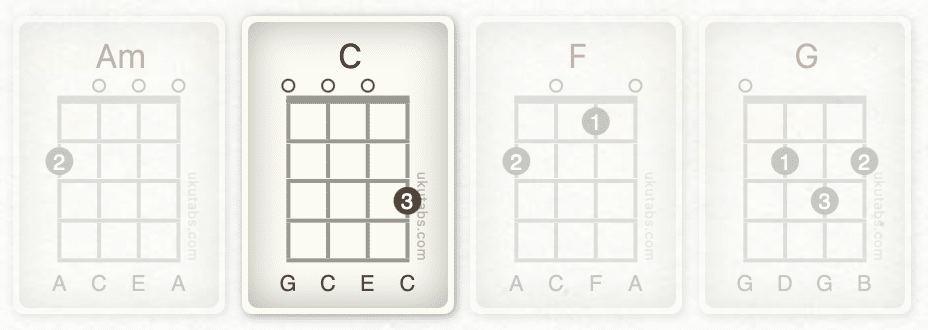
Show them to press just behind the metal fret bar, never directly on top of it, which is what gives a clean ring instead of a buzz. When they can strum C and hear all four strings sound clearly, that is a real win. Make a fuss of it and be genuinely enthusiastic, because that moment is where a lot of kids decide whether they like this or not.
From there, add shapes as their dexterity allows: Am (also one finger), then F (two), then G (three). With just those four you can already play a big share of popular songs in the key of C. If chord diagrams are the sticking point, my how to read chord diagrams guide clears that up in a few minutes and the basic chords guide is the next step up.
Strumming basics
Strumming is the heartbeat. Even two simple chords sound like music with the right rhythm behind them, so it is worth doing before you rush into songs.
Begin with one downstroke per beat and no chord at all. Count to four out loud and have them brush down across all four strings with the index finger or thumb, from the g string down to the A. The only goal is even timing. Once that feels steady, add up-strokes between the downs and let the hand bounce naturally. A metronome, physical or an app, helps a lot here. Start off slow and build up.
When they are ready for something that sounds like a real song, teach the island strum. If you only ever teach one pattern, make it this one.
Also works: down-up eighths d u d u d u d u
Written out it is d – d u – u d u, where each dash is a stroke your hand makes in the air without touching the strings. The easiest way in is to say it out loud while you play: “down, down-up, up-down-up”. Loop it until it runs by itself, slowly at first. It fits “Riptide” by Vance Joy perfectly, which is one of the most played beginner ukulele songs in the world. For the full set with audio, plus the other patterns worth knowing, see my ultimate strumming guide.
3. Switching chords and first songs
Chord transitions
Switching is the hard part, for kids and adults alike. Children especially will want to stay parked on a chord they have just conquered. Turn it into a hop: while holding C, ask them to lift their fingers and land on an Am in one movement, with no pause in between.
Practice this with no strumming at first, just the fingers moving and only ever two chords at a time. C to Am, C to F, C to G are the useful pairs. Keep their fingers low and close to the fretboard rather than flying up in the air. There is more on this in my faster chord changes guide.
Seven good first songs
Pick songs they already know, because familiarity does half the work. Go over each chord and each transition before you start, agree on a strum (plain downstrokes work almost everywhere) and let them play it slowly. Celebrate the small things: a verse without stopping, a clean change, the strum staying steady.
| Song | Chords |
|---|---|
| Are You Sleeping / Frère Jacques | One-chord version in G |
| Three Blind Mice | C, G |
| Wheels On The Bus | C, G |
| Old MacDonald Had A Farm | C, F, G |
| Twinkle Twinkle Little Star | C, F, G, G7 |
| Riptide (transposed down one) | Am, C, G |
| Somewhere Over The Rainbow | Am, C, Em, F, G (E7 optional) |
Roughly easiest first. When you need fresh material, my top 10 kids songs for ukulele list is the natural next stop. The two-chord and three-chord archives hold thousands more.
4. Adding more chords and rhythm
Once a few chords and a steady strum are in place, here is where I would go next:
- Add chords with a purpose. D, E and Em round things out nicely, but a better trick is to let them choose a song they love and learn whichever chord it needs. A shape with a song attached to it is far more motivating than a shape for its own sake.
- More patterns. Syncopated and reggae strums once the island strum is solid.
- Percussive tricks. Palm muting and the chnk are always a hit, because they make the uke sound like it has a drummer.
- Dynamics. Soft versus strong strumming and what that does to the feel of a song.
- Keep gamifying. Chord name races, fretboard hide and seek, that sort of thing.
5. Keeping them motivated
The hardest part of teaching a child is never the chords. It is holding their interest. Kids are curious and full of energy, but attention spans are short and do not ask me how I know. So I try to make the whole thing feel like play rather than work. When they are enjoying it, progress takes care of itself. Easier said than done, so here is what actually helps.
Keep it short, end on a win
Ten to thirty minutes, daily or every other day, is plenty for a young beginner. Long enough to learn something, short enough to stay focused. The important bit is how you finish: always on a small success. A short song played through, a new chord that rings clean, a strum held steady without stopping. Never end on frustration. A child who puts the instrument down feeling proud will pick it up again tomorrow and cutting a lesson short to protect that feeling is always the right call.
Let them choose the songs
Obvious, but it makes an enormous difference. If they are into Disney, Minecraft themes or Taylor Swift, use that. The lovely thing about the ukulele is that almost any tune can be reduced to a few easy chords. Every song page on UkuTabs has a transposer built in, so you can shift a song into a key that uses shapes they already know. Guide them toward things that are actually achievable, but let them pick sometimes.
Five practice games that work
- Chord bingo. A grid of chord names, marked off as they play each one cleanly.
- Chord race. Who can switch between two chords fastest. Excellent for groups.
- Ukulele Simon Says. Musical instructions instead of physical ones: “play a C”, “strum twice”, “freeze”.
- Song puzzle. Cut up the lyrics of a simple song and have them put it back in order as they play.
- Guess the string. The tuning game from earlier, which quietly builds their ear.
These work because the learning is hidden inside something familiar.
Let them write something
Once a few chords are in place, ask them to write their own song. It does not have to make sense or even sound good. If they are stuck, hand them a theme: a song about the dog or about what they had for lunch. Music is self-expression and it is worth them knowing that early, so let them improvise and be daft with it.
Small performances
Playing for someone is powerful. Call it a mini-concert rather than a performance and most of the pressure disappears. Family, a sibling, a video call to grandparents. Celebrate every milestone, however small it looks to you.
A sample six-lesson plan
A rough outline to adapt. Once you reach the end, expand in the same direction: more chords, more patterns, more variety of songs.
- Parts, posture, tuning, an open strum and the C chord.
- Downstroke strumming, reinforce C, begin chord-switch practice.
- Add Am or F. Switch C to Am to C. Play a simple song.
- Introduce G and practice switching between three chords.
- Introduce a down-up pattern and play a three-chord song.
- Game day: review, then a mini performance of one song.
Troubleshooting
| Problem | What to do |
|---|---|
| Sore fingers | Normal for untrained fingers. Switch to shorter, more frequent sessions. See sore fingers and calluses. |
| Buzzing or muted strings | Check the ukulele first, then finger curvature (use the fingertip) and placement, close behind the fret and never on top of it. My buzzing guide works through it. |
| Losing focus | Alternate playing, listening, singing and games. Switch to a song they asked for. |
| Chord diagrams confuse them | Simplify. Teach a partial chord as a stepping stone and build up. |
| Tuning confusion | Use a visual tuner like the UkuTabs one, which shows which peg belongs to which string. |
Common questions
What is the best age to start ukulele?
Around six is the usual recommendation, since younger children often struggle with coordination and attention. It varies hugely by child though. You can hand a ukulele to a younger one as a toy just to get them comfortable holding it and making sound.
What size ukulele should a child start on?
A soprano suits most young children because it is the smallest and sits closest to the body. A concert works well for older kids or anyone with longer arms. My sizes guide compares all four.
How many lessons before a child can play a song?
Often just one or two. Basic chords go in quickly and a two-chord song is playable almost immediately. That fast reward is exactly why the ukulele works so well with kids.
How often should a child practice?
Ten to thirty minutes, daily or every other day, beats one long weekly session every time. Short and frequent builds both calluses and habit without ever feeling like work.
Should I teach music theory early?
Not at the start. Focus on playing, listening and having fun. Scales and chord construction can wait until they ask, which some curious kids will.
What if they lose interest?
Stop pushing. Back off, play together for a while, pick songs they actually like and make it fun again. If the interest still does not come back, that is genuinely fine. Forcing it is the one sure way to put them off music.
Pick a song and start today
You do not need a lesson plan to begin. Tune up together on the free tuner, learn the one-finger C chord and play Frère Jacques before the session is over. That is a real song on day one, which is all the encouragement most kids need. When you want more material, my top 10 kids songs list and the two-chord songs archive will keep you going for months. Feel free to contact me whenever you need more information about teaching kids the ukulele.