
Why Won’t My Ukulele Stay In Tune? 6 Quick Fixes
 by Jonas
Ukulele keeps drifting out of tune? Do not panic. Here are the 6 most common reasons your uke will not hold its tuning, plus the simple fixes for each.
If your ukulele won’t hold its tuning, it’s almost never broken. Nine times out of ten it’s one of a handful of small, fixable things and the most common one is just brand-new strings settling in. I’ve chased this exact problem more times than I can count, so I know how maddening it feels to tune up and watch a chord go flat on you a minute later. In this guide I’ll walk you through the six usual causes and the simple fix for each, starting with the one that catches almost everybody.
A quick note first. This guide is about tuning stability, meaning the pitch sliding flat or sharp after you’ve tuned up. If your problem is a nasty buzz or rattle when you play, that’s a different beast and you want the fix buzzing and rattle guide instead.
I’d keep the online ukulele tuner open in another tab while you work through this. You’ll want to check your tuning after each fix.
1. Brand-new strings are still stretching
This is the number one reason by a mile. Fresh ukulele strings are basically little elastic bands. When you first put them on they keep stretching under tension and every tiny bit of stretch drops the pitch. So you tune up, play one chord and it’s already gone flat on you.
Better still, this is completely normal and it sorts itself out. New strings usually settle within a few days of regular playing. I always use Aquila strings (the traditional series, my favorite for years) and even those need a good two or three days to stop sagging after I fit a fresh set. So until yours settle in you’ll be retuning a lot. Don’t panic and don’t assume the uke is broken.
You can speed this up massively by pre-stretching the strings yourself. Here’s how.
How to pre-stretch your strings
- Tune the ukulele up to pitch with your tuner.
- Gently pull each string up away from the fretboard, somewhere around the 12th fret. Use light, even pressure. Think firm but kind, not yanking.
- Run your fingers along the length of the string a couple of times while you pull.
- Retune. It’ll have gone flat again, which is exactly what you want to see.
- Repeat this two or three times per string.
Do that little routine a few times over the first day or two and your strings will settle far quicker. If you’ve just put new strings on yourself, my full restringing guide walks through tying them off properly too.
2. Friction tuning pegs are slipping
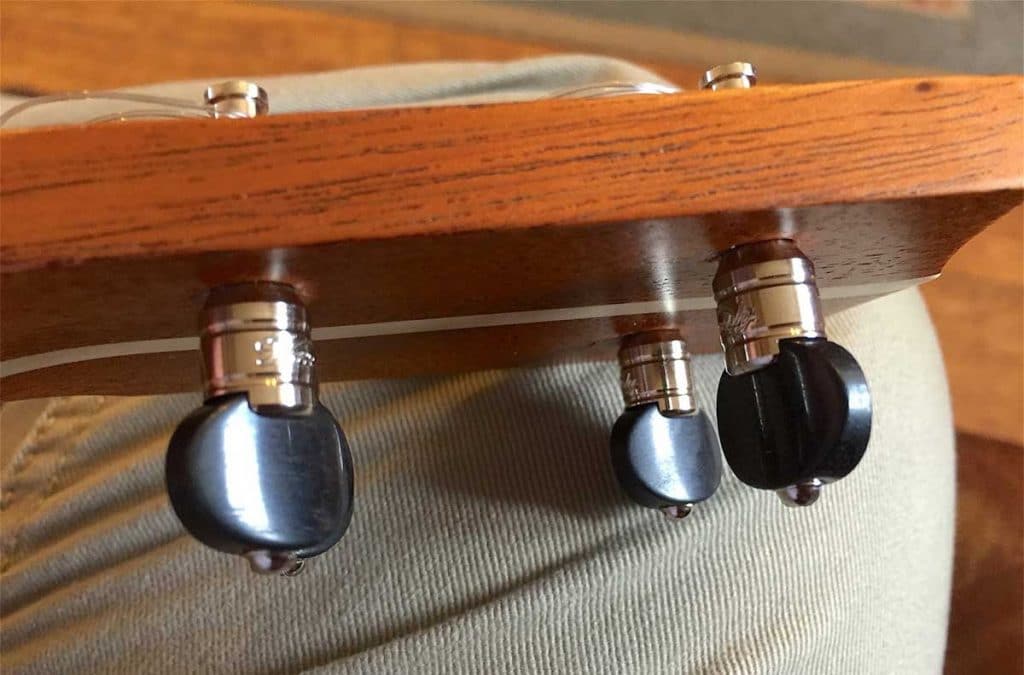
Lots of ukuleles, especially traditional and entry-level ones, use friction tuners. Those are the pegs that stick straight out the back of the headstock. They hold the string purely by friction (= grip, nothing geared) and over time that grip loosens, so the peg slowly turns back on its own and the note slides flat.
The fix is usually tiny. Look at the end of each friction peg and you’ll find a small screw. Turn it clockwise just a little, maybe a quarter turn, to add a bit of tension. Tune up, play and see if it holds. Tighten a touch more if it still slips, but don’t crank it so hard the peg becomes a wrestling match to turn.
If your friction tuners are genuinely worn out and no amount of adjusting helps, swapping to geared tuners is a brilliant upgrade. Geared tuners (usually the ones that poke out the sides) hold pitch far better and let you tune more precisely. It’s a common mod and well worth it on a uke you love.
3. The strings aren’t wound or tied neatly
A messy string job will haunt your tuning. If a string has loose coils around the tuning post, or a sloppy knot at the bridge, it keeps tightening itself up as you play. Each little shift in those coils or that knot shows up as the pitch dropping.
When you wind a string on, aim for two or three neat coils going down the post, each one below the last, with no overlapping tangles. At the bridge, make sure the knot is pulled tight and seated properly before you bring it up to pitch.
If your tuning settles for a minute then suddenly jumps, a slipping knot or untidy winding is a prime suspect. The restringing guide shows the tidy way to do both ends.
4. Temperature and humidity are swinging
Your ukulele is made of wood and wood moves. Take the uke from a warm room out into the cold, leave it next to a sunny window, or run the heating hard all winter and the wood and strings react. The result is pitch that wanders even when you haven’t touched the tuners. Think of it like a door that sticks in summer and swings freely in winter. Same idea, just on your fretboard.
You can’t argue with physics, but you can be kind to your instrument. Keep it away from radiators, direct sun and drafty doorways. Don’t leave it in a hot car or a freezing trunk. If your home gets very dry, a case humidifier helps a lot, especially with solid-wood ukuleles. I use an Oasis humidifier in mine and it’s saved me a lot of grief over the dry months.
There’s more on protecting your uke from the elements in the take care of your ukulele guide. A stable home means a more stable tuning.
5. You’re playing or fretting too hard
Here’s a sneaky one. If your tuning reads perfect on the open strings but goes sharp the moment you fret a chord, the problem might be your hands. Pressing down too hard, or strumming like you’re cross with the thing, pushes the strings sharp and makes everything sound slightly off.
Try a lighter touch. You only need just enough finger pressure to get a clean note, no more. Same with your strumming: relaxed and even beats hard and tense every single time. This also makes your playing sound better, so it’s a win twice over.
If you’re not sure what a relaxed strum feels like, my strumming guide covers using your wrist instead of your whole arm. Test it on a few easy open chord shapes like these.
Fret each one gently, check it against the tuner and feel how little pressure you actually need.
6. Cheap strings or a rough nut slot
If you’ve worked through everything above and the uke still won’t behave, the hardware itself might be the issue. Really cheap strings can be inconsistent and refuse to hold pitch no matter what you do. A fresh set of decent strings often fixes a stubborn uke on its own and my best ukulele strings guide points you to sets worth your money.
The other common culprit is the nut, the little grooved piece where the strings cross at the top of the neck. If a slot is too tight or rough, the string catches there instead of sliding freely. You tune up, the string is pinched and then it pops loose mid-song and goes flat. A tiny bit of pencil graphite rubbed into the slot helps the string glide. If the slot is genuinely cut wrong, that’s a quick job for a proper setup.
Quick recap
Most tuning trouble comes down to one of these:
1. New strings still stretching: pre-stretch them and give it a few days. 2. Friction pegs slipping: tighten the little screw, or fit geared tuners. 3. Untidy winding or knots: wind neat coils and seat the knot. 4. Temperature and humidity swings: keep your uke somewhere stable. 5. Heavy fretting or strumming: lighten up your touch. 6. Cheap strings or a rough nut: upgrade the strings, smooth the slot.
Work through them in order and nine times out of ten your ukulele will be holding pitch like a champ. New strings are the usual answer, so if yours are fresh, give them a few days of playing before you blame anything else. It can feel fiddly at first, but you can do it!
I hope this guide has helped you get your ukulele staying in tune. Once it holds steady, pop open the tuner, get it spot on and go play something fun. Keep on practicing and enjoy! Feel free to contact me whenever you need more information about keeping your uke in tune. Good luck and have fun!
Some links on this page are Amazon affiliate links. As an Amazon Associate, UkuTabs earns from qualifying purchases at no extra cost to you.