
How To Hold A Ukulele
 by Jonas
A relaxed, balanced way to hold a ukulele, sitting or standing, so chords ring clean and you can play for an hour without aching. The setup I teach every beginner, with photos.
Since I started posting videos on the UkuTabs YouTube channel, the question I get asked most is how to hold a ukulele properly. It is not hard, but a relaxed, balanced hold makes everything else easier, from clean chords to playing for an hour without aching. Here is exactly how I do it, plus the few mistakes worth avoiding.
The short version: rest the ukulele against your chest, hold it there with your strumming forearm and keep your fretting hand free to move. Everything below is just the detail that makes that comfortable.
How to pick up a ukulele
Always pick a ukulele up by the neck, where the neck meets the body. Do not swing it around by the headstock and do not lift it by reaching into the soundhole, because both can warp the neck or the body over time. It sounds fussy, but a ukulele is a light, hollow box and it bends more easily than you would think.

How to hold it against your body
Hold the ukulele against your chest with your strumming forearm, not with your fretting hand. There is no single correct way to do it, so aim for relaxed and comfortable rather than rigid. Here is the setup I teach:
- Rest the body of the ukulele against your chest.
- Lay your strumming forearm across the top edge of the lower body to pin it gently in place.
- Keep that elbow around 90 degrees to start. It will open up as you actually play, so do not try to lock it there or you will strain your arm and back.
- Check your grip: let go of the neck for a second. If the ukulele stays put on its own, you have it.
If it slips, hold a little tighter, but do not squeeze the neck itself because bending it pulls the strings out of tune.
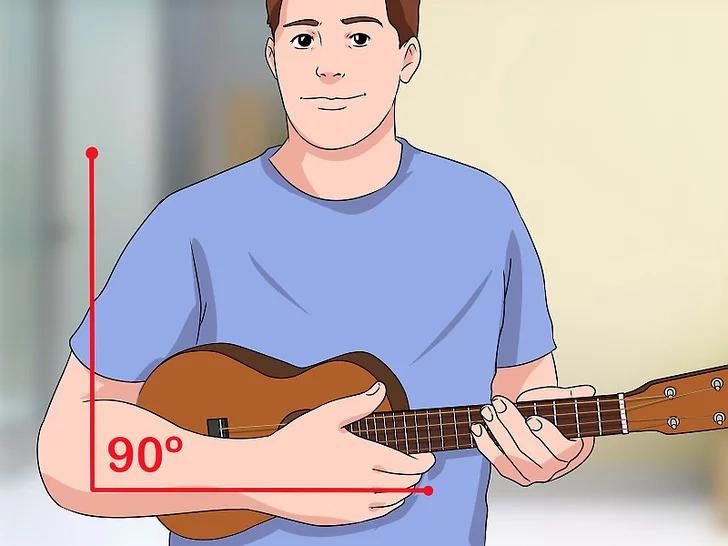
Find the angle that suits you
There is no single correct angle, so tilt the ukulele until it feels natural. Some players keep it horizontal, while others tilt the neck slightly upward to reach awkward chords more easily. Adjust it freely as you play so your hand never has to strain for a shape.
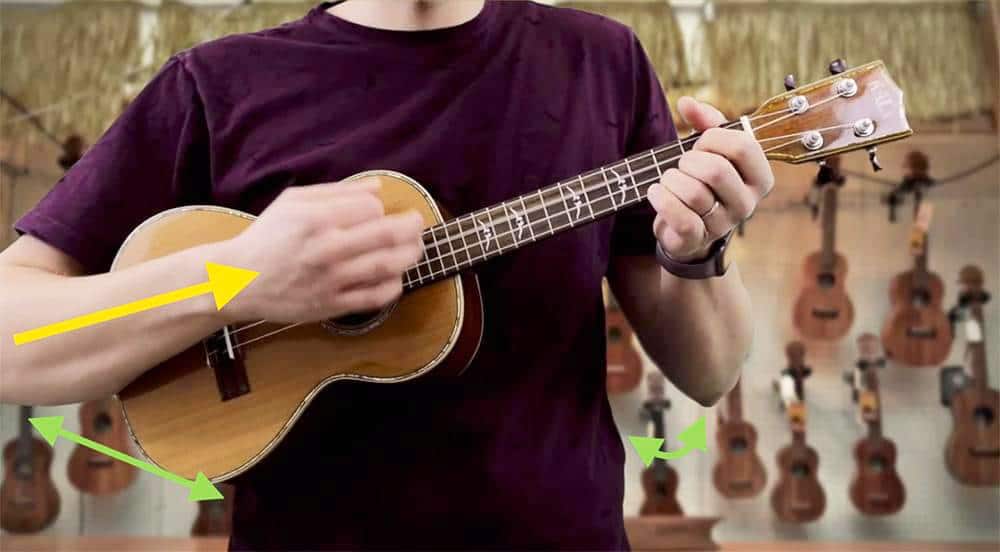
Free up your fretting hand
Your fretting hand should never carry the weight of the ukulele, because it is busy making chords. If your holding arm is doing its job, your fretting hand is free to float over the strings.
Place your thumb behind the neck, somewhere between the nut and the third fret, ideally with the pad of the thumb on the back rather than wrapped over the top, which gives your fingers more room to reach across the strings. I will be honest though, I wrap my thumb over the neck most of the time because my fingers are long enough to reach and it feels comfortable, so do not tell my mom. Wrap your other fingers around the front so they sit parallel to the frets and float just above them, ready to drop onto a basic chord.
Keep your strumming arm relaxed
Keep your strumming elbow away from your body so there is a straight line from your elbow to your wrist. Do not clamp it against your side. A loose, open strumming arm is what lets you keep a steady rhythm once you start working on your strumming.
Sitting or standing
The same hold works whether you are sitting or standing, so start seated because it is the easiest. Rest the body on your leg as well as against your chest and let your forearm settle it in place. Standing up you lean on your forearm to hug the uke to your chest, which is fine for a song or two. For anything longer a strap is worth it. It actually frees your fretting hand completely, because the strap carries the weight instead of your arm. Many ukuleles have no strap button, so a soundhole-hook strap or a clip-on two-button strap is the easy fix.
Smaller players have an easier time seated too. If a child or anyone with short arms is struggling, a soprano sits closer to the body than a bigger size. A strap helps just as much here.
Left-handed players
If it feels more natural to play left-handed, do it. Most people are right-handed, but there is nothing wrong with being a lefty. The chord diagrams tool and the tuner both have a left-handed mode, so you can see every shape mirrored. If you would rather not reverse the instructions in your head, you can restring the ukulele to flip the string order.
Common mistakes to avoid
If something feels wrong, it is usually one of these. Here is the quick fix for each.
| Mistake | Do this instead |
|---|---|
| Swinging the uke by the headstock or lifting it by the soundhole | Pick it up by the neck where it meets the body |
| Squeezing the neck to stop it slipping | Hold it in place with your strumming forearm, not your grip |
| Letting your fretting hand carry the weight | Let your holding arm do that so your fingers stay free |
| Clamping your strumming elbow to your side | Keep a straight line from your elbow to your wrist |
| Locking your elbow at a rigid 90 degrees | Treat 90 degrees as a starting point and let it move |
Common questions
How do I hold a ukulele while sitting?
Rest the body against your chest, hold it there with your strumming forearm and rest it on your leg for extra support. Your fretting hand stays free to make chords. This is the easiest position to start in.
How do I hold a ukulele standing up?
Hug the body to your chest with your strumming forearm and keep your fretting hand free. If it slips while you stand, a strap takes the weight so both hands can relax.
Do I need a strap to hold a ukulele?
Not usually. A ukulele is light enough to hold against your chest with good technique. A strap mainly helps if you play standing for long stretches or find the uke hard to keep steady.
How should a child hold a ukulele?
The same way, just seated, with the body resting on a leg and against the chest. A smaller soprano size suits small hands. A strap can help a child keep it steady while they learn.
How do left-handed people hold a ukulele?
Hold it the mirror image of a right-handed player, with the fretting hand on your right. You can use the left-handed mode in the UkuTabs chord and tuner tools, or restring the ukulele to reverse the string order.
Need more input?
That really is all there is to it. A hold you do not have to think about frees you up to focus on the music, which is the whole point. Feel free to contact me whenever you need more information about holding your ukulele. Once your grip feels natural, the next step is to tune up and run through my top tips for beginners.
Hi so I recently took up ukulele, I am finding that I am having troubles twist my wrist enough to wrap my fingers around to get the notes without accidently touching the other strings. Do you have any tips that might help me twist my wrist more?
Ok I have took it upon me to realize most ukelele players have skinny fingers and I don’t so I can’t play a D or anything across the ukelele or I touch other strings any tips
right when I started I was holding it a little wonky but then I got the feel for it and now I am teaching my brother and cousin
I’m stressing out so much but I’m dedicating myself to learning the ukulele but the hand placements for the cords are so hard, lowkey want cry 😭🥲
hii ! im a lefty and i find it hard to play normal chords but ive been playing ukelele left handed for a while and im making progress ! Ive been meaning to get my strings changed but i never know where to go or what to do any help ?
You are
Thank you!
I was trying to learn how to do bar cords and I hurt my tumb. Now I find it hard to do any kind of cord that involves reaching are what you call a hard cord. This has been about a year. Do you have any subjections. Thanks