
Ukulele Keys: The Chords In Every Key
 by Jonas
·
by Jonas
·
Every key is just a home note and the small family of chords that sound right together. Here are the chords in every common key in one chart, then how I turn them into a song of my own.
Want a song to sound good? The trick is that the chords are not random. They come from a key, which is just a home note plus the small family of chords that sit happily around it. Pick a key and you have a ready-made set of chords that are almost guaranteed to sound right together.
This page does two jobs. First it gives you the chords in every common key in one chart, so you can look up exactly what to play. Then I show you how I take those chords and turn them into a song of my own. There is a free printable Key Card at the bottom too.
What is a key on ukulele?
A key is a home note plus the family of seven chords built from its scale. Those seven chords are the ones that sound right together. Songs stay in one key because all their chords come from that single family. The key of C, for example, is built around the note C and hands you the chords C, F, G and a few friends.
You do not need to understand where the chords come from to use them. You can grab a key from the chart below and start playing right away. If you do want the deeper why, it lives in the notes of the scale, which I cover in my scales guide.
The circle of fifths
The circle of fifths is the classic map of every key. Keys that sit next to each other share almost all of their chords, which is why moving from C to G feels so natural. Each major key is also paired with its relative minor on the inside ring.
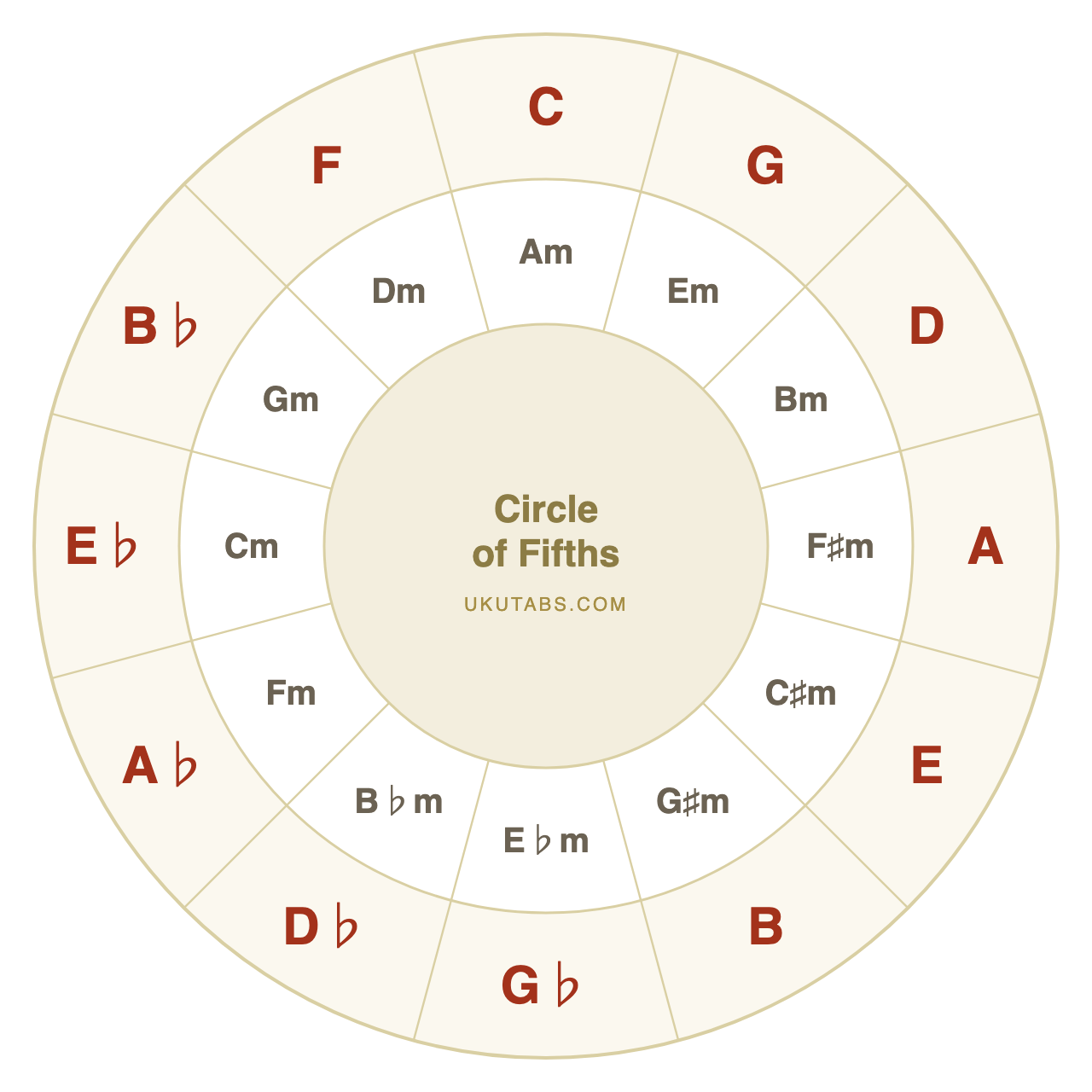
Ukulele chords by key
These are the ukulele chords in every common key, the full chart. The Roman numerals along the top are the scale degrees and each one has a job:
- I is home, the chord everything resolves to (its proper name is the tonic).
- IV and V are the subdominant and dominant, the next most important. They pull strongly back toward home.
- ii and iii are softer minor chords that add gentle movement and color in between.
- vi is the relative minor, the moody one.
- vii° is a tense diminished chord. You will rarely strum it on its own, because a diminished chord sounds unstable by design and its tension wants to fall straight to the I, so most players let the V do that job instead.
The shaded I, IV and V are the three you will use most.
Major keys
| Key | I | ii | iii | IV | V | vi | vii° |
|---|---|---|---|---|---|---|---|
| A major | A | Bm | C#m | D | E | F#m | G#dim |
| B major | B | C#m | D#m | E | F# | G#m | A#dim |
| C major | C | Dm | Em | F | G | Am | Bdim |
| D major | D | Em | F#m | G | A | Bm | C#dim |
| E major | E | F#m | G#m | A | B | C#m | D#dim |
| F major | F | Gm | Am | Bb | C | Dm | Edim |
| G major | G | Am | Bm | C | D | Em | F#dim |
New to one of these shapes? My basic chords guide covers the common ones, or you can look any chord up in the chord diagrams tool.
Minor keys
A minor key is built on a minor home chord, written i, and it sounds darker than a major key. It borrows all seven of its chords from a major key, called its relative major, which is why the same shapes keep showing up. Here is every common minor key.
| Key | i | ii° | III | iv | v | VI | VII |
|---|---|---|---|---|---|---|---|
| A minor | Am | Bdim | C | Dm | Em | F | G |
| B minor | Bm | C#dim | D | Em | F#m | G | A |
| C minor | Cm | Ddim | Eb | Fm | Gm | Ab | Bb |
| D minor | Dm | Edim | F | Gm | Am | Bb | C |
| E minor | Em | F#dim | G | Am | Bm | C | D |
| F minor | Fm | Gdim | Ab | Bbm | Cm | Db | Eb |
| G minor | Gm | Adim | Bb | Cm | Dm | Eb | F |
That major-and-minor pairing is called relative keys. The shaded i, iv and v are again your main three.
Your three main chords: I, IV and V
The I, IV and V are the three main chords in any key. They are the backbone of more songs than any other combination. If you only learn three chords in a key, learn these. In the key of C that is C, F and G. In the key of A it is A, D and E.
Those three chords are the whole of Three Little Birds by Bob Marley, which lives happily in the key of A. Play A, D and E in a loop and you are already playing a real song. Want more like it? The three-chord songs archive is full of them.
Add the relative minor for feeling
Add one more chord and your songs grow a heart. The vi chord, the relative minor, is the wistful member of the family. In the key of C that is Am. Slip it in among C, F and G and a cheerful progression suddenly has some shade to it.
These four chords, the I, V, vi and IV, are behind a huge share of pop songs, which is why people call it the four-chord trick. In the key of C that is C, G, Am and F.
You have heard it in hundreds of songs, including I’m Yours by Jason Mraz. Once your ear knows the sound you will catch it everywhere. The four-chord songs archive is full of them.
Progressions you can write today
Here are five progressions worth knowing. Pick a key, swap in its chords from the chart and loop each one until it grooves.
| Progression | What it gives you | In the key of C | In the key of G |
|---|---|---|---|
| I – IV – V | the classic three-chord song | C, F, G | G, C, D |
| I – V – vi – IV | the famous pop progression | C, G, Am, F | G, D, Em, C |
| vi – IV – I – V | a moodier spin on those same four | Am, F, C, G | Em, C, G, D |
| I – vi – IV – V | the dreamy 50s doo-wop sound | C, Am, F, G | G, Em, C, D |
| ii – V – I | a smooth, jazzy landing | Dm, G, C | Am, D, G |
The same patterns work in any key. That is the whole point of thinking in keys instead of memorizing every song from scratch. Learn a progression once and you can move it anywhere.
The dominant 7th, the chord that pulls home
One chord in every key has a special pull: the V turned into a seventh. Take the V chord and add a flat seventh on top and you get a dominant 7th, like G7 in the key of C. It sounds slightly unfinished, which makes your ear ache to land back on the I. That tension and release is what makes a progression feel like it truly resolves.
Try ending a phrase in C with G7 going home to C instead of plain G and listen to how much stronger the pull is. There is a whole seventh chords guide if you want to explore maj7, m7 and the rest of the family.
You can even borrow a dominant 7th from another key to lead somewhere new. B7 does not belong to the key of G, but because B7 is the dominant 7th of E minor it pulls beautifully into an Em:
That borrowed chord is called a secondary dominant and it is one of the easiest ways to make a plain progression sound clever. Minor keys borrow a major-sounding dominant like this all the time, which is why B7 leads home to Em even though the chart lists Bm as the v.
How I write a song in a key
Here is how I actually start a song once I have a key in mind.
- Pick a key that suits my voice, usually C or G because the shapes are easy and I can sing comfortably in that range.
- Loop one of the progressions above, like C, G, Am, F, until it feels like a real groove and not just a row of chords. That steady loop is the floor everything else stands on.
- Hum a melody over the top before I write a single word. The chords are the floor, the melody is the song. Humming first stops me forcing the words too early.
- Find the spots that want to lift or darken. That is where I reach for the relative minor to add a little ache or a dominant 7th to pull hard into the next chord.
- End on the I so the song feels finished and resolved, then go back and shape the words to fit the melody I found.
That is the whole loop. Pick a key, pick a progression, hum and let the words come last.
How to find the key of a song
The fastest way to find a song’s key is to look at the chord it ends on, since songs almost always finish on their home chord. Here is the full method.
- Look at the last chord of the song. Songs almost always end on the home chord, the I. If a song ends on G, it is very likely in the key of G.
- Check it against the chart. Find the row where that chord is the I and see whether the song’s other chords mostly fit that row. If they do, you have found the key.
- Still unsure? The first chord is the next best clue, since plenty of songs also open on the I.
If you have worked a shape out by ear and cannot name it, the chord namer will tell you what it is. And once you know the key you can move the whole song into one that suits you, which I cover next.
Pick a key that fits your voice
The friendliest keys on ukulele are C, G, D, A and F, along with the minor keys Am, Em and Dm. They are full of easy open shapes. If a song sits too high or too low for you to sing comfortably, do not force it. Move it into a friendlier key with my transpose chords guide.
A capo is the lazy way to do the same thing. Clamp it on and keep playing the same easy open shapes, but everything sounds higher. Play your C, F and G shapes with a capo on the 2nd fret and you are really in the key of D, with no new chords to learn. Every UkuTabs song page also has a built-in transposer that shifts a song into any key in one click.
Try this now
Pick the key of C. Play C, then G, then Am, then F, four strums each, then loop it for two minutes without stopping. That is the most famous progression in pop music and you already own it in one key. Tomorrow, move the exact same pattern to the key of G (G, D, Em, C) and feel how the shapes change but the song does not.
Get the free Key Card
Want all of this on one printable sheet to keep by your uke? Grab the free downloads below. The Key Card lists the keys and their chords at a glance. The guide PDF walks through how to use it.
Common questions
What chords are in the key of C?
The key of C uses C, Dm, Em, F, G, Am and Bdim. The three you will reach for most are C, F and G, with Am close behind as the relative minor.
What chords are in the key of G?
The key of G uses G, Am, Bm, C, D, Em and F#dim. Your three main chords are G, C and D, with Em as the relative minor.
What chords are in the key of D?
The key of D uses D, Em, F#m, G, A, Bm and C#dim. The three you will use most are D, G and A, with Bm as the relative minor.
What chords are in the key of A?
The key of A uses A, Bm, C#m, D, E, F#m and G#dim. Your main three are A, D and E. Three Little Birds lives in this key.
What chords are in the key of A minor?
A minor uses Am, Bdim, C, Dm, Em, F and G. It shares all its chords with the key of C, which is why it is the easiest minor key to play.
What is a I-IV-V progression?
It is the three main chords of a key played together, the most common pattern in popular music. In the key of C that is C, F and G. In the key of G it is G, C and D.
What is the relative minor?
Every major key has a minor key that shares the exact same chords, called its relative minor. It sits on the vi chord, so the relative minor of C is Am and of G is Em.
How many chords are in a key?
A key has seven chords, one built on each note of its scale. Most songs only use three or four of them though, usually some mix of the I, IV, V and vi.
What is the easiest key on ukulele?
C is the friendliest, since C, F, G and Am are all simple shapes. G, D, A and F are easy too. I would steer clear of flat-heavy keys like E flat or A flat while you are starting out.
How do I know if a song is in a major or minor key?
If the song sounds bright and lands on a major chord at the end it is major. If it sounds darker and ends on a minor chord it is minor. The final chord is your best clue.
How do I change a song to a different key?
Move every chord up or down by the same number of steps, or use a capo to shift them all at once. Every UkuTabs song page also has a one-click transposer that does it for you.
How do I find the key of a song?
Look at the chord the song ends on, which is almost always the home chord. Find it as the I in the chart above and check that the other chords fit the same row. That row is your key.
Need more input?
I hope this makes keys feel less like theory homework and more like a toolbox you can actually write with. Pick a key, loop a progression and see what comes out. Feel free to contact me whenever you need more information about writing ukulele songs with keys.
huh?
How can I get to change from each note more quickly from G to F and AM to C etc.
I am asking as a complete beginner.
Thank you in advance
Lele
all of the scales except C are wrong
the a# scale has a few double sharps, which means to write it correctly would be:
A# B# C## D# E# F## G## A#
there’s a typo in the A scale: A B C# D **F** F# G# A
that F should be an E