
Which Christmas Songs Are Public Domain? I Checked 44 Carols
 by Jonas
Silent Night is free for anyone to use. White Christmas won't be until 2038. Here's the 2026 rule, which carols are free, when the famous songs will be and the surprises I found checking 44 carols for my songbook.
Silent Night is more than 200 years old and anyone can print it, record it or sell it. White Christmas is 84 years old and won’t be free in the US until 2038. Somewhere between those two the rules get surprisingly fiddly.
I found that out while putting together Jingle Strums, my ukulele Christmas songbook. Every one of its 44 carols had to pass a copyright check before it could go in. Not just the carol itself, but every layer of it: the tune, the words, the translation and even the version people actually sing. A few that everybody assumes are free turned out to have a catch.
So here’s what I learned, in plain words: the rule for 2026, which carols are free, when the famous songs will be and six surprises I didn’t see coming. One thing up front: I’m a ukulele player who did a lot of homework, not a lawyer. If you’re about to sell something, check with someone who is.
What makes a song public domain in 2026?
There are two rules and which one counts depends on where you are.
| Where | A song is public domain in 2026 if… |
|---|---|
| United States | it was first published before 1931 |
| UK, EU and many other countries | everyone who wrote it (music, words and any translation) died before 1956 |
The US counts from publication. A song published before 1978 is protected for at most 95 years, until the end of its 95th year. That’s why songs from 1930 became free on 1 January 2026 and songs from 1931 follow on 1 January 2027. Europe and the UK count from the writers instead: 70 years after the last of them dies.
So a carol can be free in one country and protected in another. That’s why every song in my book had to pass both tests at once: published in the US before 1931 and every writer dead before 1956. If you want something you can use anywhere, that double test is a handy rule of thumb.
Which Christmas carols are public domain?
All of these pass both tests, so they’re free in the US and in Europe. I’ve listed when each was first published and the year the last of its writers died, which is the number Europe cares about. Every one of them has a free page on UkuTabs with the chords and the full words.
| Carol | First published | Last writer died |
|---|---|---|
| Silent Night | 1833 (written 1818, English words 1859) | 1885 |
| Jingle Bells | 1857 | 1893 |
| Joy to the World | 1719 words, 1836 tune | 1872 |
| Deck the Halls | 1794 tune, today’s words 1877 | 1873 |
| Away in a Manger | 1882 words, tunes 1887 and 1895 | 1932 at the latest |
| Up on the Housetop | 1866 | 1867 |
| O Christmas Tree | 1799 tune, this English text 1916 | anonymous |
| Good King Wenceslas | 1853 words, 1582 tune | 1866 |
| The First Noel | 1823 words, 1833 tune | anonymous |
| We Three Kings | 1863 | 1891 |
| O Come, All Ye Faithful | 1751 (English words 1852) | 1880 |
| Hark! The Herald Angels Sing | 1739 words, 1840 tune | 1915 |
| What Child Is This | 1871 (written 1865, tune 16th century) | 1898 |
| O Holy Night | 1847 (English words 1855) | 1893 |
| O Little Town of Bethlehem | 1868 | 1908 |
| It Came Upon the Midnight Clear | 1849 words, 1850 tune | 1900 |
| In the Bleak Midwinter | 1872 words, 1906 tune | 1934 |
| The Twelve Days of Christmas | about 1780, today’s version 1909 | 1952 |
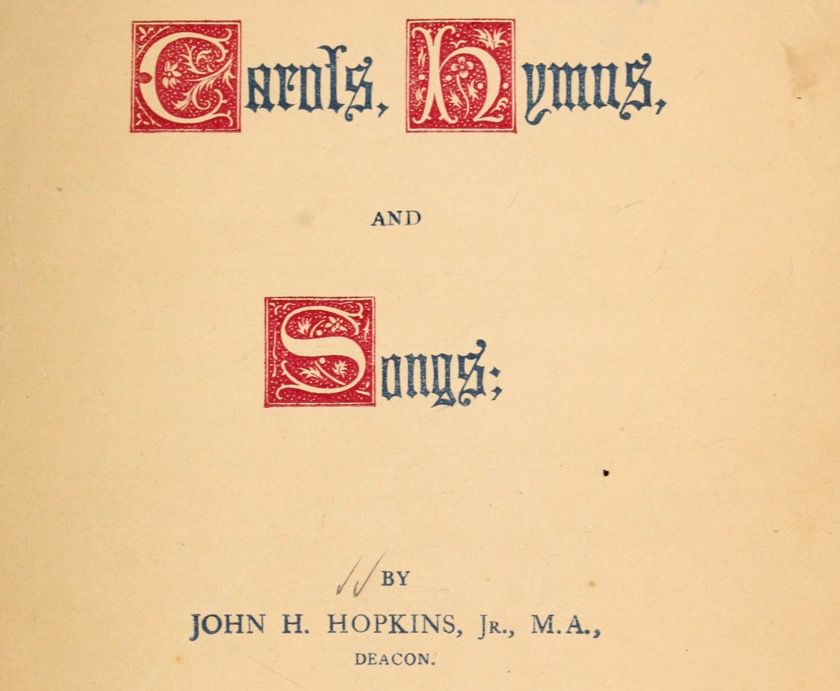
The newest one on the list is The Twelve Days of Christmas. The version everyone sings today was arranged by Frederic Austin in 1909 and he died in 1952, so in Europe it only became completely free on 1 January 2023.
Which famous Christmas songs are still under copyright?
Almost every Christmas pop song you know. Here’s when the big ones become free in the US, counted from the year they were first published. In Europe it takes longer still, because the clock only starts when the last songwriter dies.
| Song | Published | Free in the US from |
|---|---|---|
| Winter Wonderland | 1934 | 2030 |
| Santa Claus Is Comin’ to Town | 1934 | 2030 |
| White Christmas | 1942 | 2038 |
| Have Yourself a Merry Little Christmas | 1944 | 2040 |
| Rudolph the Red-Nosed Reindeer | 1949 | 2045 |
| Frosty the Snowman | 1950 | 2046 |
| Jingle Bell Rock | 1957 | 2053 |
| Feliz Navidad | 1970 | 2066 |
| Last Christmas | 1984 | 2087 |
| All I Want for Christmas Is You | 1994 | 70 years after its writers die |
Two of those need a word. Rudolph the reindeer first appeared in a 1939 storybook, but the song only came in 1949 and that’s the date that counts. And from 1978 on the US switched to the European-style rule for new songs, which is why Last Christmas stays protected until 2087: George Michael wrote it on his own and he died in 2016.
Why a carol is never just one copyright
This is the part that catches people out. A carol isn’t one thing, it’s a stack of layers and each one has its own clock:
- The tune. Usually the oldest part.
- The words. Often written by someone else, sometimes centuries later.
- A translation. The English words of Silent Night are by John Freeman Young from 1859, not by Joseph Mohr, who wrote the German.
- An arrangement. The harmonies and chords of one particular published version.
- A recording. A copyright of its own, separate from the song.
Away in a Manger shows how this works. The words and both of its tunes are free. (Yes, both: Americans usually sing James R. Murray’s tune from 1887 and Brits sing William J. Kirkpatrick’s from 1895. And no, Martin Luther didn’t write it, that story was made up in the 1880s.) But the choir arrangement many people grew up hearing, by David Willcocks in 1961, is still protected.
Recordings work the same way. Bing Crosby’s Silent Night is still protected even though Silent Night isn’t. In the US a recording stays protected for about a century or longer, so in 2026 only recordings from 1925 and earlier are free.
The good news for anyone with a ukulele: writing your own chords and strum for a free carol is completely fine and the arrangement is yours. Copying the arrangement out of a recent published songbook isn’t the same thing.
Six surprises I found checking 44 carols
- Carol of the Bells is only half free. The music is by Mykola Leontovych, first published in Ukraine in 1918 as Shchedryk. He died in 1921, so the tune is free. The English words everybody knows (“Hark how the bells…”) were written by Peter Wilhousky in 1936 and stay protected in the US until about 2032. That’s why it’s an instrumental in my book.
- The We Wish You a Merry Christmas everyone sings first appeared in 1935. The song is traditional, but the famous tune and the figgy pudding verses were first printed in Arthur Warrell’s 1935 arrangement, which is protected in the US until 2031. Warrell himself registered it as a “West Country traditional song”, which is what keeps the song itself free. His version even says “I wish you”. The “we” came later.
- The Bring a Torch, Jeannette, Isabella words most Americans know aren’t the free ones. The free English translation is E. Cuthbert Nunn’s from 1909, which starts “Bring a torch, to the cradle run!” The more familiar “Bring a torch, come swiftly and run” has no known author and I couldn’t find it in print before 1967, so I treated it as protected.
- It’s “five gold rings”, not “golden rings”. The Twelve Days version everyone knows is Frederic Austin’s from 1909, including that long held “five gold rings”. “Golden rings” came from Mitch Miller’s 1961 recording. And the “calling birds” were once “colly birds”, an old word for blackbirds.
- Still, Still, Still has no free English words. The Austrian carol and its German text from 1865 are free. Every English singing version I could find was either a mid-century copyright or couldn’t be traced back before 1931. So my book prints it in German.
- Deck the Halls used to be a drinking song. Thomas Oliphant’s English words from 1862 had lines like “Fill the meadcup, drain the barrel”. The “Don we now our gay apparel” version everyone sings is an American rewrite from 1877. Both are free, so take your pick.
Does any of this matter if you just want to play?
Mostly no. Playing a song at home, with friends or around the tree has never needed anybody’s permission, carol or not.
It starts to matter when you:
- print copies, like a Christmas songbook for your ukulele group
- record your version and release it, online or on a streaming service
- sell anything with the song in it
For those, the free carols are the easy part. Use the old words, write your own chords and you’re set. For the songs that are still protected, you usually need a license first, which is a whole different job.
Where can you play these carols?
Every carol in the first table has a free page here on UkuTabs with the chords, every verse and a suggested strum you can hear before you play. There are more than 140 songs in the Christmas section and if you’re new, my top 10 easy Christmas songs is the place to start.
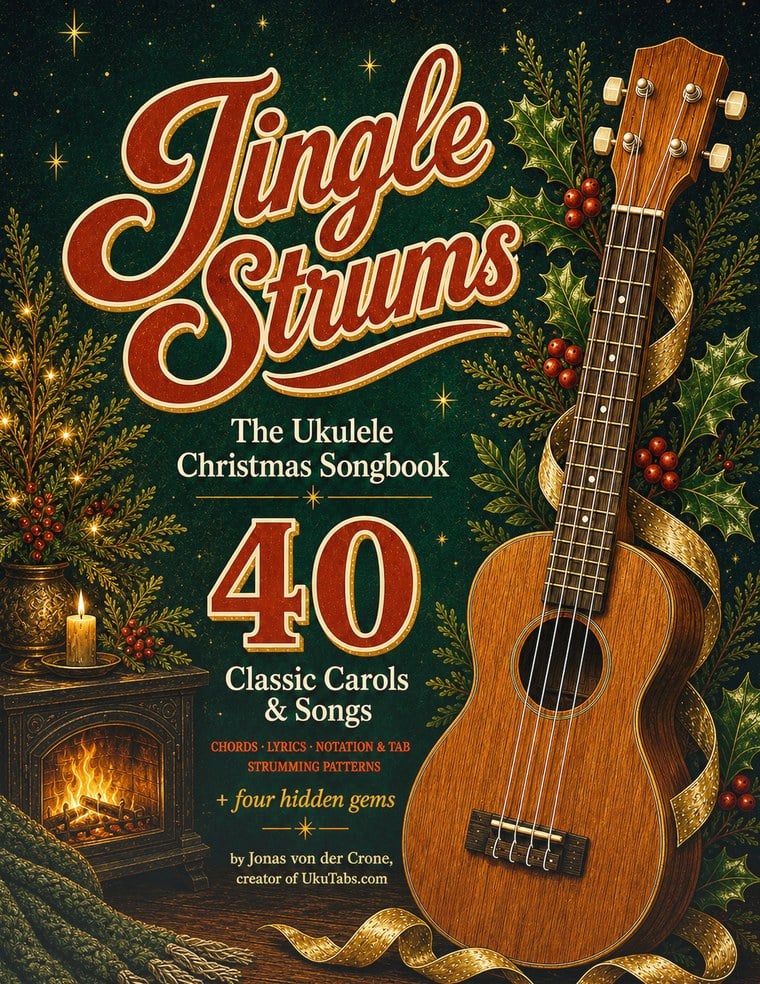
If you’d rather play from paper, all 44 carols I checked are in Jingle Strums with every verse in full and the melody in notation and tab. Those two tests are the reason the book looks the way it does: it’s 44 songs I knew I could print.
And until Christmas I’m sending one song to play every Friday in my newsletter. You can sign up at the bottom of any page.
Frequently asked questions
Is Jingle Bells public domain?
Yes. James Lord Pierpont published it in 1857 and died in 1893, so it’s free in the US and in Europe.
Is Silent Night public domain?
Yes, including the English words most people sing, which John Freeman Young translated in 1859. Particular recordings and modern arrangements of it are a different story.
Is Carol of the Bells public domain?
The music is. Mykola Leontovych’s tune was first published in 1918 and he died in 1921. The English lyrics by Peter Wilhousky from 1936 aren’t: they stay protected in the US until about 2032.
Is White Christmas public domain?
No. Irving Berlin’s song from 1942 stays protected in the US until 1 January 2038 and for longer in Europe.
When will Rudolph the Red-Nosed Reindeer be public domain?
In the US, on 1 January 2045. The song is from 1949, even though the reindeer first appeared in a storybook in 1939.
Is We Wish You a Merry Christmas public domain?
The traditional song is treated as free. The 1935 arrangement by Arthur Warrell that made it famous is protected in the US until 2031, so play the plain tune with your own chords.
Can I share a recording of myself playing a public domain carol?
Your own performance of a free carol, with your own arrangement, is yours to share. What you can’t do is use somebody else’s recording or copy a recent published arrangement.
Pick one of the free ones, tune up and play it this weekend. Silent Night is three chords and more than two centuries old, which makes it about the safest song in the world to practice. If you spot something I got wrong, tell me and I’ll fix it. Happy strumming!
