
How To Read Ukulele Chord Diagrams
 by Jonas
·
by Jonas
·
On a ukulele chord diagram the vertical lines are the strings (G, C, E, A from left to right) and the horizontal lines are the frets. A dot shows where to press a finger, an O above a string means play it open, and an X means do not play it. A number at the side means the shape starts higher up the neck.
A chord diagram is a small map of the ukulele neck. Once you know the five symbols below you can read any chord shape on sight, which makes learning songs much faster.
How to read ukulele chord diagrams? It’s really easy!
The ukulele chord diagrams are quite intuitive to understand, but some symbols may need some explaining. Once you know how the chord diagrams work you will be glad to see them on song pages, because it will really help you learn a song faster. Read on to learn how to read ukulele chord diagrams.
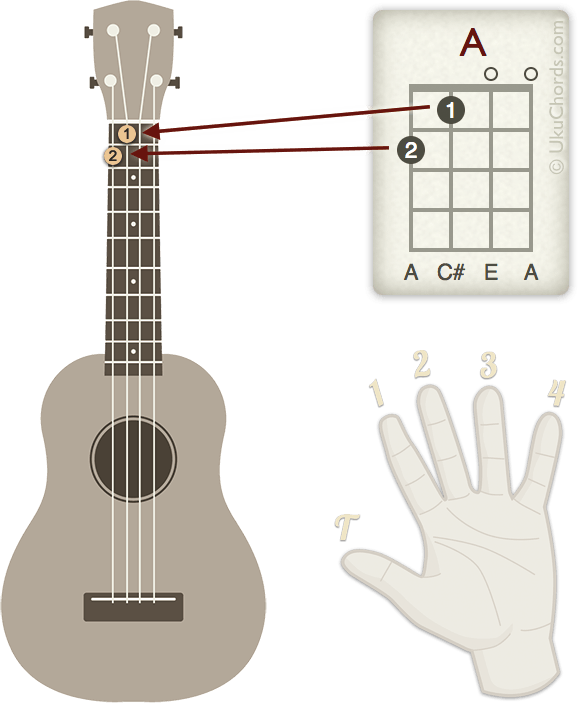
Chord diagrams (as seen on UkuTabs)
Here is what every part of a UkuTabs chord diagram means.
| Symbol | Means | What to do |
|---|---|---|
| Vertical lines | Strings | Left to right they are G, C, E, A |
| Horizontal lines | Frets | The top line is nearest the headstock |
| Dot | Finger | Press that string at that fret |
| O (circle on top) | Open string | Play it without pressing any fret |
| X | Muted string | Do not play it, rest a finger on it to mute |
| Number at the side | Starting fret | The shape is played higher up the neck |
| Thick line across | Barre | Press several strings down with one finger |
1. The basics
The UkuTabs chord diagrams are quite easy to understand and I’ve made them as simple as possible. You should imagine there is a ukulele in front of you and you are looking at the fretboard with the headstock at the top. The strings are illustrated as vertical lines (from left to right G C E A string) and the frets are the horizontal lines.
All the different chord shapes are represented by dots. Each dot represents the placement of your finger. In the example above, you can see a G chord. In numbers that is G = 0232 (G open, C 2nd fret, E 3rd fret, A 2nd fret). So how should you place your fingers? You play the C string at the second fret, the E string at the third fret and the A string at the second fret. That little circle (o) at the top of the G string means that you have to play that string open (i.e. not place a finger on it).
This is a basic chord diagram and most of time you will see diagrams like this. However, there are a few symbols that need some explaining. Once you get the hang of them, you will know how to read ukulele chord diagrams.
2. Higher up the fretboard
Sometimes you will see numbers at the sides of diagrams. These refer to a certain fret number, because sometimes a chord is played higher up the fretboard (if there are no numbers, it means frets 1 to 4 are shown). In this example the G, C and E strings are played at the sixth fret and the A string at the eighth fret, which in numbers is 6668.
3. Muting
If you see a little “x” at the bottom (or top) of a string it means you should not play that string at all. In other words, you have to mute it. You can do this by resting one or more of your fretting fingers on the string without actually fretting it. An example is shown above. In numbers that is X124, where the X means the G string is muted.
Text chords
Sometimes you won’t see chord diagrams in the score for a song, but only four simple numbers. Sometimes people talk about chords this way as well. For example, “0232” represents a G chord. The four numbers refer to each string of the ukulele (order: GCEA). This is incredibly useful to tell someone quickly how to play a certain chord. The second example in this guide would be 6668 and the third one X124.
| Chord | Numbers (GCEA) | How to play |
|---|---|---|
| G | 0232 | G open, C 2nd fret, E 3rd fret, A 2nd fret |
| C | 0003 | G, C, E open, A 3rd fret |
| Am | 2000 | G 2nd fret, C, E, A open |
| F | 2010 | G 2nd fret, C open, E 1st fret, A open |
UkuTabs chord charts
Discover the complete ukulele chord charts for soprano, concert and tenor ukuleles. It features all the main chord diagrams, and you can either download a print-friendly pdf or a “poster-like” chart.
Chord diagrams vs tabs vs sheet music
A chord diagram shows one chord shape at a glance. A ukulele tab is a timeline of single notes for riffs and picking. Standard sheet music shows pitch and rhythm on a staff and takes longest to learn. For playing songs from chords, diagrams are all you need.
Ukulele chord diagram FAQ
What do the numbers on a ukulele chord diagram mean?
They show which fret to press, and sometimes which finger to use: 1 = index, 2 = middle, 3 = ring, 4 = pinky. A number at the side of the grid means the shape is played higher up the neck.
How do I know which string is which in a chord chart?
Diagrams are drawn vertically. The left line is the G string, then C, then E, and the right line is the A string, matching the order as you hold the ukulele in front of you.
What does an O or X at the top of a chord diagram mean?
An O above a string means play it open, with no finger on the fret. An X means do not play that string, or mute it.
How do I read barre chords on a ukulele chart?
A barre is shown as a thick line across several strings, or the same finger number on all of them. You press those strings down at once with one finger, usually your index.
Why do some diagrams show circles above the nut?
Those circles mark open strings. They remind you that even though you do not press a fret, that string is part of the chord and should be played.
What is the difference between a chord diagram, a tab, and sheet music?
A chord diagram is a snapshot of one chord shape, showing where to put your fingers. A tab is a sequence played over time: numbers on four lines tell you which fret to pick on each string. Sheet music uses standard notation on a five-line staff to show exact pitch and rhythm. Most ukulele players only ever need chord diagrams and tabs.
Try it on a real chord
Open any song and the chords show as these diagrams. Browse the full ukulele chord library, name a shape you do not recognize with the chord namer, and tune up first with the free ukulele tuner.
how do u find the strumming pattern?
hi i am new i naed help
Can anyone better explain this please I am so confused
I’m in search of songs with guitar chords over the lyrics. Did I see a “guitar” option here at the uke headquarters??
ok so when theres like more than one number 1 on the thing do you use the same finger?
does a UKE benefit from have an “pickup” and amplifier installed
How long wil it take to learn the ful notes and get them right and how do I tune a uke
How do I do it if there is more then the 1 circle?
Im sooo lost right now. Please explain
why is there numbers like g7 or d7
What if the vertical chords don’t have GCEA at the bottom? What if it says A/EB/A/C? I have a picture for reference.
I want to learn chord progression on my baritone. Is there a rolling chart?
guys what does it mean when somebody says 1+ 2+ etc.?
I would like to know how you read the intro notes on a baritone tab sheet.
how do i know which direction to strum and how often/to what rhythm?
how do i change the chord charts from c tuning to d tuning?
How I know the strumming pattern?
I DONT UNDERSTAND ALMOST EVERYTHING
How do I play the tabs not the cords but the other kind
What is the correct way to strum the ukulele? I have been using my fingertips, shaped loosely like a claw, but I have seen suggestions that I should use my thumb?