
How to Play the E Chord on Ukulele (and Easier Alternatives)
 by Jonas
·
by Jonas
·
The E chord is the one that trips up almost every beginner. Here is the easy no-barre way to play it, the full barre version, and easy substitutes for when you get stuck.
The E chord is the one almost every ukulele player gets stuck on, so if it has been driving you mad, you are in good company. The good news is that you do not have to wrestle with the hard barre version at all. UkuTabs shows the E as an easier, no-barre shape, and that is where we will start. Below you will also find the traditional barre version and a couple of substitutes for when a song hits you with an E before your fingers are ready.
The short answer: the easiest way to play the ukulele E chord is the no-barre shape 1 4 0 2. First finger on the 1st fret of the g string, another finger on the 4th fret of the C string, leave the E string open, and a finger on the 2nd fret of the A string. It is a full, proper E major and it is the version you will see on UkuTabs song pages.
The easy E chord (no barre): 1 4 0 2
This is the shape to learn first, and the one listed in the UkuTabs chord library. Here it is on the fretboard:
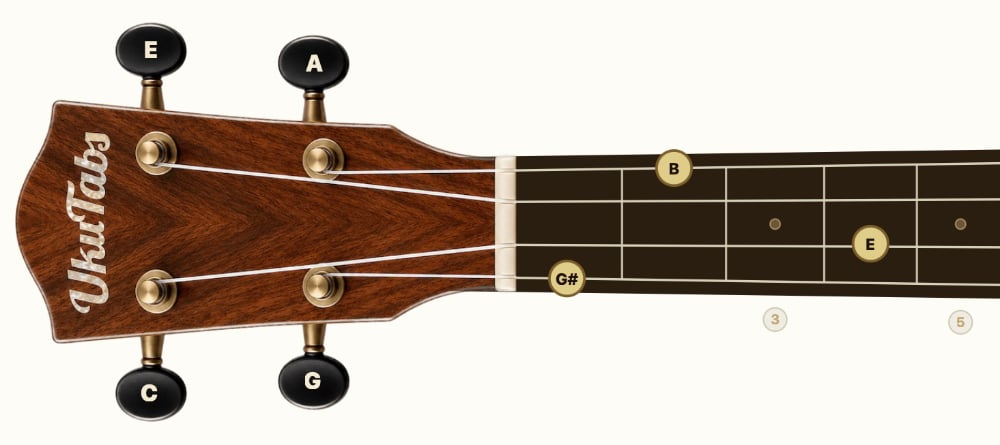
Play it 1 4 0 2:
- g string: 1st fret (first finger)
- C string: 4th fret (ring or little finger)
- E string: open, leave it ringing
- A string: 2nd fret (middle finger)
Because there is no barre, it rings out clearly and lets you change to and from it quickly. For the vast majority of songs you can use this version and never touch the harder one. If the numbers are new to you, our guide to reading chord diagrams explains them in five minutes.
The traditional barre E: 4 4 4 2
You will also see the E written as 4 4 4 2. This is the textbook shape, and it sounds a touch fuller, but it is the one that earns the E its scary reputation:
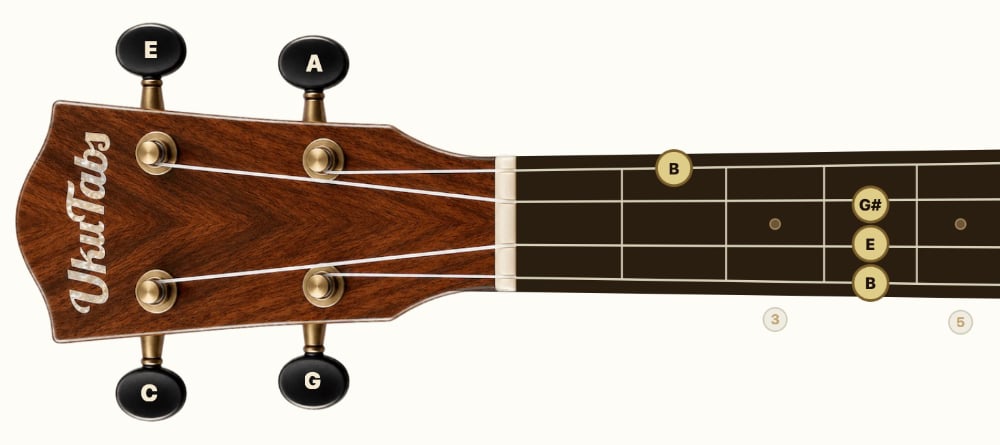
- Index finger on the 2nd fret of the A string.
- Middle, ring and little finger on the 4th fret of the g, C and E strings, one finger per string.
Three fingers crammed onto one fret is awkward, so most players switch to a barre once their hand is stronger: lay one finger flat across the 4th fret of the g, C and E strings and keep your index on the 2nd fret of the A string. Some people even hook their thumb over the top. If barring is new to you, our guide to bar chords walks through the technique step by step. There is no rush to get here, the 1 4 0 2 shape will keep you playing in the meantime.
Other shapes and easy substitutes
There is more than one way to play an E, plus a couple of easier substitutes for when even 1 4 0 2 is a stretch. If E is still out of reach, an E5 power chord or an E7 is much friendlier. Here they are on the fretboard:
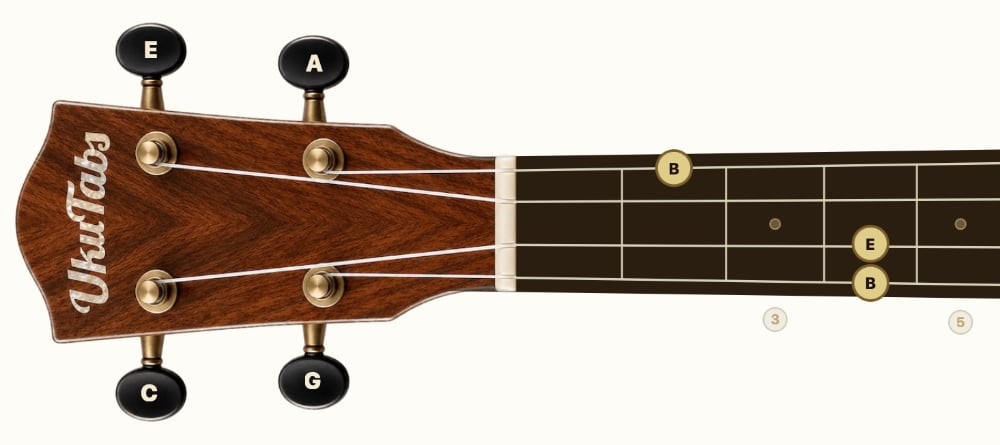
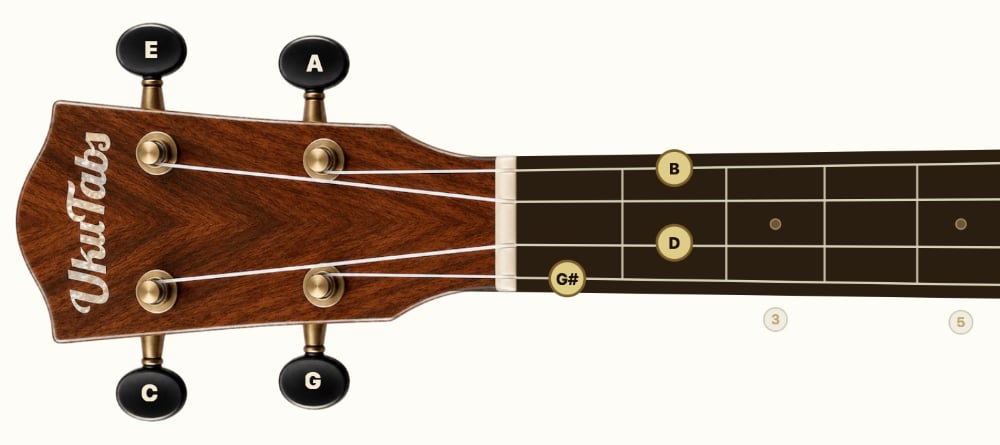
Here is every option side by side. The fret numbers run g C E A, lowest string to highest.
| Shape | How to play it | Difficulty | How it sounds |
|---|---|---|---|
| Full E major (the real chord) | |||
| Easy E 1 4 0 2 | g 1st fret, C 4th fret, E open, A 2nd fret. No barre. | Medium | Clear and bright. The best first choice. |
| Barre E 4 4 4 2 | Index on A 2nd fret, barre or three fingers on g, C and E at the 4th fret. | Hard | The fuller, traditional E. Worth learning in the long run. |
| High E 4 4 4 7 | Barre the 4th fret across g, C and E, little finger on A 7th fret. | Hard | Big and ringing, higher up the neck. A real stretch. |
| Easier substitutes (not a full E) | |||
| E5 power chord 4 4 0 2 | Like the barre E but leave the E string open, so it is one less finger. | Medium | A power-chord E5. No major or minor flavour, but it fits a lot of songs. |
| E7 substitute 1 2 0 2 | An easy shape most beginners already know. | Easy | Not an E, but an E7 often works where a song asks for E, especially leading into A. |
Substitutes change the sound a little, so use your ear. In a pinch you can also let UkuTabs do the work: the Simplify trick swaps tough chords like E for easier shapes while you build up to the real thing.
Why is the E chord so hard?
It is not just you. The full barre E packs three fingers onto the 4th fret, right next to a note on the 2nd fret, on a fretboard barely wider than your hand. When I started out I knew Am, C, G and F within weeks, then slowly added A, D, Dm, Em and more. Every time a song had an E in it, I skipped it. You cannot dodge it forever though, because it turns up in a huge number of well-known songs. The trick is to start with the 1 4 0 2 shape, lean on a substitute when you need to, and come back to the barre once your hand is ready.
How to practice the E chord
A few things that make it click faster:
- Start with 1 4 0 2. Get comfortable and musical with the easy shape before you fight the barre.
- Press close to the fret. Put your fingers just behind the metal fret wire, not in the middle of the gap, so the notes ring without buzzing.
- Arch your fingers. Come down on your fingertips so you do not accidentally mute the next string.
- Practise the change, not just the shape. Switch slowly between E and the chords it actually sits next to in your songs, usually A and B7. Our guide to faster chord changes has drills for exactly this.
- Expect sore fingertips. They settle down as you build calluses. Short, daily reps beat one long session.
- Check your action. If the strings sit high off the fretboard, every chord is harder. A ukulele with a good low setup makes the E much friendlier.
E chord questions, answered
How do you play the E chord on a ukulele?
The easiest way is the no-barre 1 4 0 2 shape: first finger on the g string 1st fret, a finger on the C string 4th fret, the E string open, and a finger on the A string 2nd fret. It is a full E major and it is what UkuTabs shows on song pages. The traditional barre version is 4 4 4 2.
What is the easiest way to play the E chord?
The 1 4 0 2 shape, because there is no barre. It is far kinder to beginners than the textbook 4 4 4 2 while still being a proper, full-sounding E major.
What can I use instead of the E chord?
If E is still out of reach, try the E5 power chord (4 4 0 2) or substitute an E7 (1 2 0 2). Both are easier and work in many songs, though they change the sound slightly. The UkuTabs Simplify trick can swap E chords for you automatically.
Is E7 a good substitute for the E chord?
Often, yes. E7 (1 2 0 2) is much easier to fret and works well in songs where E leads back to A. It adds a bluesy seventh note, so it will not suit every song, but it is a great stopgap while you learn the full E.
Why is the E chord so hard on the ukulele?
The barre version crowds three fingers onto the 4th fret next to a 2nd-fret note, on a short fretboard. That cluster feels unnatural at first. It gets much easier with the 1 4 0 2 shape and a little practice.
Is the E chord the hardest ukulele chord?
For most beginners it is the one that causes the most grief, along with full barre chords like B flat and B. The difference is that E has easy alternatives, so you can keep playing songs while you work up to the barre shape.
That is the whole E chord, from the easy shape that gets you playing today to the fuller version worth growing into. Be patient with your fingers and you will have it before long. When you are ready for more, brush up on the basic chords every player should know, or put your new E to work on thousands of songs.
I never even knew about the alternative for E! This is really helpful <3
I think the widely accepted E chord is much easier than the other alternative, it strains my hands 😐
another easy way to play e is to play it like the e7 chord but mute the c string (the thickest one)
The standard e chord seems so much easier omg
I started with the chords C, Am, F, and G. It was super easy but when my teacher let me play songs like “A Million Dreams” and “How Far I’ll Go” which have hard chords like D, Dm, Fm, Em, and others, I usually do this: I try to play it on my first day, then next day it’s magic; I can do it already. But when I saw the E chord, I thought “Nah, not going to learn this.” But I know some point I need to know, so I’m trying to keep up with your advice! Thanks!
E7 MY BELOVED
I started playing seriously a few months ago and have progressed pretty well, but even now at the point i can play and switch between chords like D, F, G, C, all of their sevens and others, i still really struggle with the E, except for Em which is a pretty simple shape just in a weird spot. Ive read all the variations but im just still not sure why i cant progress more on it.
This is helpful omg
My hands are too small to play the 1402 one (◞‸◟)
Love it!
I am trying to find my accountt
Thank you for the alternative E chord, I always struggle to play it.
0442 and mute the G string is the easiest form of Emaj for me.