
Top Ten Ukulele Tips For Beginners
 by Jonas
·
by Jonas
·
The ten ukulele tips I give every beginner, from picking a uke that stays in tune to building calluses without sore fingers. These are the things I wish someone had told me on day one.
You just got your first ukulele and you want to start the right way. Good. These are the ten tips I give every beginner, built from the things I got wrong when I started and a couple of personal ones the other lists leave out. Work through them in order and you will sound better and quit less.
Here are the ten tips, in the order I would tackle them:
- Buy a ukulele that stays in tune.
- Learn to hold it in a relaxed way.
- Tune up every single time you play.
- Learn a handful of basic chords first.
- Work on steady, simple strumming.
- Use UkuTabs chord diagrams to learn songs.
- Practice slowly for clean chord changes.
- Train your ears by playing along and recording yourself.
- Build calluses with short daily finger drills.
- Keep it fun and play a little most days.
There is a bonus eleventh tip on fingernails at the end too. Now here is each one in full.
1. Get a decent ukulele
Spend around $100 on your first ukulele so that it actually stays in tune. There are good options in that range, but below about $50 you can be fairly sure it will fight you. The main problem is that it won’t stay in tune.
I am speaking from experience. I once bought a $45 soprano that could not hold its E string in tune for a single strum, which is the fastest way to get discouraged. Have a look at my ukulele buying guide to find the right one for your budget and read what to know before you buy too. If you possibly can, try a few in a local shop before you decide.

2. Learn to hold it properly
A relaxed, balanced hold makes every chord ring cleaner and saves your hands. Sitting down, rest the body on your leg and let your strumming arm sit lightly on top, with the neck floating up in the air. Standing up, hold it against your chest and pin it gently with your strumming forearm.
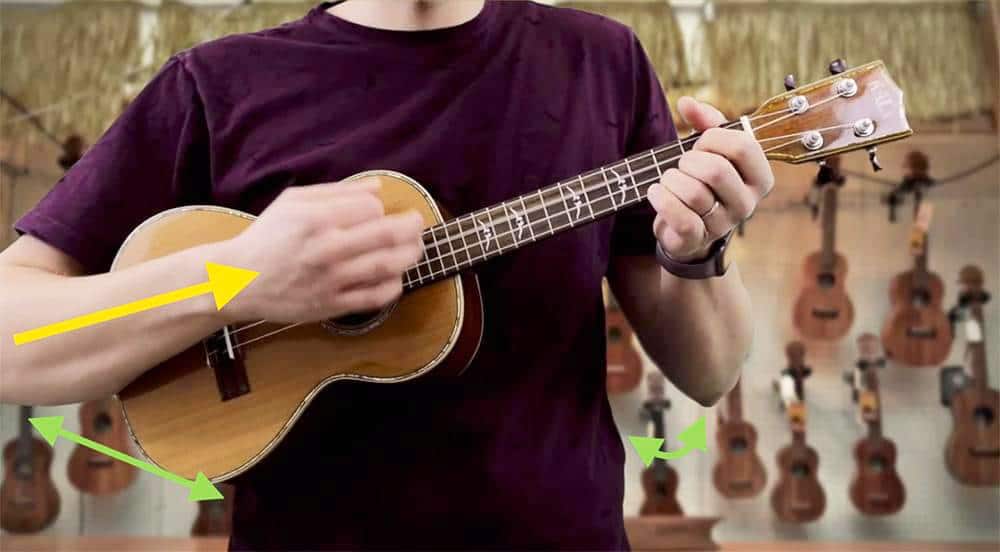
It takes a little practice, but soon you will pick the uke up and play without fussing over position first. One quick thing: do not grip it too tightly, because the body needs to vibrate to sound good. There is a full walkthrough in my how to hold a ukulele guide. You probably do not need a strap to start, but if the uke slips or your fretting hand ends up doing the holding, a strap fixes that fast.
3. Tune up every single time
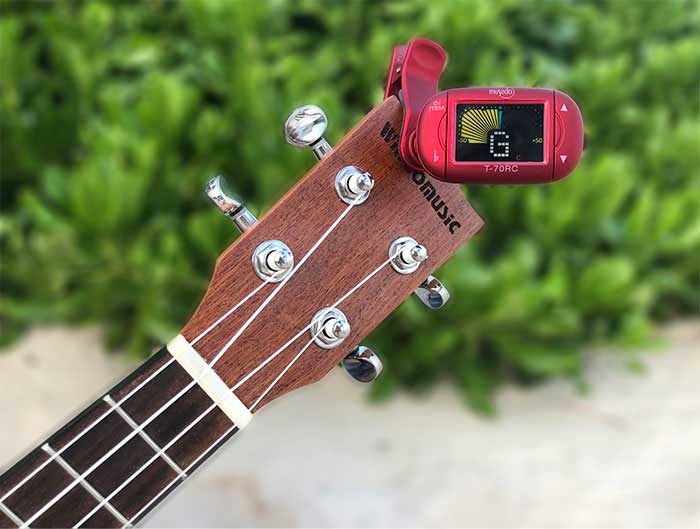
Tune before every session, without exception. A beginner ukulele drifts quickly and most “I sound bad” moments are really just “I am out of tune.” It is also the habit that trains your ear. Use the free UkuTabs tuner or a clip-on tuner, then check your strings before you play a single chord. My tuning guide covers standard gCEA tuning and how to keep it stable.
4. Start with the basic chords
Learn a handful of basic open chords first, the common majors and minors, because they unlock most beginner songs. Do not chase big fancy tabs on day one. Start small and build out from there. These four are the ones I would learn first:
You can look up the shape for any chord on the chord diagrams tool.
Once a few chords are under your fingers you will be playing whole songs without thinking twice. My basic chords guide is the place to start. If you want to understand why certain chords belong together, my ukulele keys guide lays it out.
5. Decent strumming makes all the difference
Steady, simple strumming will carry you further than any fancy pattern. At the start you will mostly do down and up strums, which is fine. Later you can add palm muting and a percussive chnk for that funky, groovy feel. I keep the full how-to in my ultimate strumming guide.
Wondering why strumming patterns are not posted alongside songs? It is a copyright thing. The MPA (Music Publishers Association) does not allow the rhythm and tempo of a song to be shared online, so I cannot post them even though I would love to. The bright side is that working a strum out by ear is one of the fastest ways to improve, so listen closely and feel the rhythm.
6. Use UkuTabs to learn songs
The easiest way to learn a song is to use a chart that shows you the chords as you go. Every song on UkuTabs displays the diagram for each chord it uses, so you never have to go hunting for shapes. Hover over a chord and its diagram pops up. You can also transpose the whole song into an easier key with one click using the selector on each song page. When you are ready, go play your first full song start to finish.
7. Play as slowly as you can
Play slowly enough that every note stays clean, then build up speed from there. Once your basic chords feel comfortable you can start switching between them, so practice that a lot with lots of different pairs. Accuracy matters far more than speed at this stage. The speed arrives on its own once the changes are clean. There are real tricks to get there faster in my faster chord changes guide. The same goes for tabs: aim for no buzzing, start with slow easy songs and gradually speed up.
8. Train your ears by playing along and recording yourself
The fastest way to develop feel is to listen hard, both to others and to yourself. Play along with ukulele videos or jam with a friend to soak up the groove, watching for tempo and rhythm. Then record yourself on your phone and listen back. I got that second half from UkuleleHunt and it is gold, because it is hard to play and really listen at the same time, so often just noticing the problem is enough to fix it.
9. Build calluses with finger exercises
Sore fingertips are completely normal when you start, your skin just has not toughened up yet. Keep playing and you will build calluses within a week or two, less painfully with nylon strings than steel ones. Short daily sessions build them faster than the occasional long one, so stop if it genuinely hurts and come back tomorrow. There is more on managing this in my guide to sore fingers and calluses.
Here is a simple drill I learned from Faye Hicks. Run through it a few times at the start of each session:
- Pluck the first string open.
- Press just behind the 1st fret with your index finger and pluck.
- Add your middle finger on the 2nd fret and pluck, then your ring finger on the 3rd and pluck.
- Add your pinkie on the 4th fret and pluck that note twice.
- Climb back down the same way: ring finger, middle finger, index finger, then the open string again.
- Move to the next string and run the whole pattern, working across all four.
It toughens your fingertips and limbers up both hands. Aim for ten to fifteen minutes a day rather than one marathon session. If you want a whole book of drills, “Ukulele Aerobics” by Chad Johnson and “Ukulele Exercises For Dummies” by Brett McQueen are both excellent.
10. Keep it fun and play a little most days
The beginners who stick with it are not the most talented, they are the ones who practice a little most days instead of a lot once a week. So protect the habit. Leave the ukulele out on a stand where you can grab it, then play something you enjoy at the end of every session. Some people call the uke a toy, but a real instrument that makes you smile is exactly the kind you keep picking up. Do not give up too early, because progress comes faster than you expect.
11. One bonus tip: mind your fingernails
Keep the nails on your fretting hand cut VERY short. It is essential for a clean sound, because you press the strings with the very tips of your fingers. On your strumming hand you can let them grow a little, especially if you are getting into fingerpicking.
Common questions
What ukulele should a beginner buy?
A concert or soprano in the $70 to $120 range from a known brand. Below about $50 the tuning gets unreliable, which is the fastest way to get discouraged. My buying guide lists tested options for every budget.
How do I start playing the ukulele?
Tune up, learn three or four basic chords, then practice switching between them slowly. Once the changes are clean you can play along to easy songs, which is where it gets fun. Speed and fancy patterns come later.
How many chords do I need to start?
Three or four. C, G, Am and F alone cover a huge number of beginner songs. You can add more once switching between those feels easy.
Why do my fingers hurt when I play ukulele?
Sore fingertips are normal for the first couple of weeks, since your skin has not built calluses yet. Short daily practice toughens them up fast and the soreness fades. Stop if it genuinely hurts and come back the next day.
Do I need a strap for ukulele?
Not to start. A ukulele is light enough to hold with good technique, so most players never use one. A strap helps if you play standing for long stretches or struggle to keep it steady.
How long does it take to learn the ukulele?
You can strum your first song within a week and feel comfortable in a few months. Fifteen focused minutes a day gets you there faster than the occasional long session.
Need more input?
I hope these give you a real head start. Feel free to contact me whenever you need more information about getting started. When you are ready, go learn your first song.
Thanks
I think i just shat myself
Thanks, tip 10 is a winner!
thanks just bought one based on your advice for my daughter and look forward to learning how to play together.
You all need to please stop putting weird comments on this website. This is for ukulele tips and tricks not for you to have a free therapy session to state all your problems and annoying dirty jokes. Because big surprise nobody wants to read the comments of people who are being immature. We are here to have tips and tricks on how to become a better ukulele player and so please please please stop this madness.
On a different note, I loved these tips and tricks and I think these are totally useful for people who want a little help with the ukulele but do not want to watch a video. This is confusion free and helped me so much I totally recommend this to anyone! 10/10 stars for these tips!
It’s a pity that strumming patterns aren’t provided, could you however provide a list of common strumming patterns instead? Just in one of the blog post type things.
What is wrong with some of you guys there are probably young kids that use this site and I know that if I were a parent I would report you guys. So maybe think about what your writing on here cause it’s not cool
I just got an ukelele and just found this site – thank you so much, it has soooo much value! All very useful tips. I’m already having so much fun with my uke 💖
Hello Support,
I have Ernie Ball ends with the low G,
Question is the thick string ,Wound ball end 4th the first string on the right handed Tenor Ukelele?
Please reply,
Deane Vuijst Kuijer
[email protected]
thankyou! it really helps me as a beginner.
Hi
I didn’t know about number 11 THANKS
i need to see a therapist after this one
why? this tutorial is … just no
Hi people
these are really helpful
Thanks for hte great tutroial.
Thank you! I’ve been playing for probably 6 years. I don’t play a ton but this website has helped me slip right back into the rhythm whenever I’m back at it! I’ve always been a drummer first and foremost but the Uke allows me to maintain an understanding of melody/chords and keep my vocals in tune!
Thanks 🙂
HAHAHAHAAAAAHHAHAHAH AH AH ahahahaha