
If you’re thinking about teaching a kid (your child, student, your class, niece/nephew…) how to play ukulele, I wrote this to be your one-stop guide. I will walk you through the steps I would suggest with tips, sample lesson ideas, troubleshooting ideas and of course some links to useful UkuTabs tools you can embed or share freely.
Why teach kids ukulele?
If you need any more convincing why the ukulele is the perfect instrument to teach kids, here are a few reasons why I love it:
- It’s small and lightweight (easy for little hands). There are different ukulele sizes that can grow with the kid.
- Nylon strings are generally gentler on fingertips compared to steel strings on guitar.
- There only four strings = fewer chord shapes to start, compared to the six strings on guitar.
- It’s fun and can give quick gratification since many simple songs can be played after just one or a few lessons.
That being said, I do want to note that every child is different! Some pick it up fast, others need more encouragement. The ukulele and playing the ukulele should be fun! The goal isn’t perfection at all. It is all bout building confidence, musical awareness and enjoyment. It can also strengthen the bond with the kid or kids you are teaching.
The Step-by-Step Method
Here is a quick overview of steps that I would recommend. You can adapt the pace to the child’s age, attention span and motivation.
| Stage | Objectives | Suggested Tools / Exercises |
|---|---|---|
| 1 | Basics: parts of the ukulele, holding it, basic posture, tuning | Chord diagrams, “name that part” games, tuning app or tuner |
| 2 | The first chord(s) and learn strumming | One or two simple chord shapes + a very basic strum (downstroke) |
| 3 | Switching chords, first simple songs | Practice transitioning, learn a 2 or 3-chord song |
| 4 | Rhythm, strumming patterns adding chord knowledge | Introduce up/down strums, patterns, transition chords |
| 5 | Games, songs, performance, creativity | Play along favorite songs, improvise, pick favorites, mini-concerts |
1. Getting Started: Introduce the Ukulele
1.1 Parts, posture and holding
Start with showing them the parts on the ukulele: body, neck, fretboard, strings, sound hole, bridge, tuning pegs. I often draw a simple sketch or use the labelled diagram found in the main ukulele parts guide. You can have them point or name each part. Of course you can also use the actual ukulele you have available.

When holding the ukulele for the first time, focus on them holding the ukulele gently and avoid gripping it too tightly. Show them how to rest it on the lap (when sitting) or with a strap (if small size allows). They will be eager to touch the strings and make sound. Don’t block it, but let them strum the ukulele open with their strumming hand (no fingers on frets at all with the other hand) so they hear how it sounds just by strumming.
1.2 Tuning the ukulele
Tuning is something kids (and honestly adults as well) often find frustrating. Definitely with a new ukulele and can take a few tuning sessions before it stays in tune. A quick tip is to over tighten it every so slightly and leave it like that for 1 day. Then tune it like you normally would do and it should now stay in tune.
I recently revamped the UkuTabs tuner to be super versatile. It can be found on the homepage as well as the ukulele tuner page. You can use the microphone of your computer or smartphone and it will intuitively help you and the kid tune the ukulele. Kids often see at as a video game to make the green light of the string light up and make the needle go to the center. If you prefer to tune by ear, that is also perfectly possible by using the “tone mode”.
Something I like to do in between sessions is to play the “guess the string” game. I hit a random string and ask them to match it. This is both training their hearing and tuning by ear skill as well as learn them which is string is which (G, C, E and A in standard ukulele tuning) which will be super helpful for learning chords later on.
Do not expect them to get perfect tuning right away. Their ears will develop and get better and better.
2. First Chords and Strumming Patterns
2.1 Choose an easy first chord
If you want to dive into a set of basic chords, you can check out this guide I’ve written to get you started, but with kids it’s better to start slowly with only a single chord. The C chord is often the easiest to start with as it uses only one finger: ring finger on the 3rd fret of the A string (bottom string).
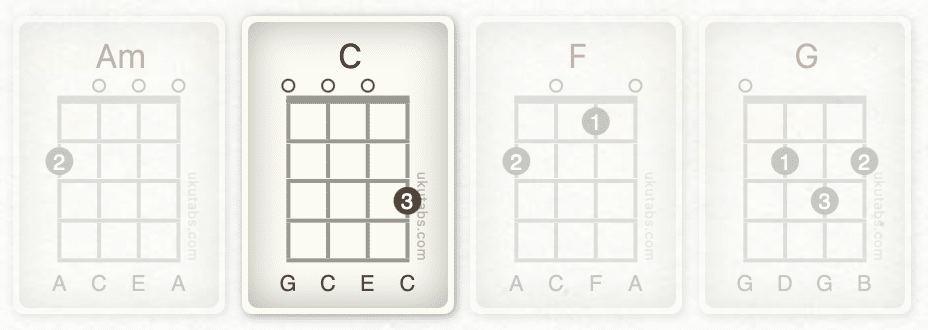
Important: Show them how to press close to the metal bar (the fret), but never not on top of it to get a clean ring.
Once they can play C cleanly, meaning that they can strum and each of the four strings sound free, that’s a win! Encourage them and be enthousiastic about it. You might try to introduce the Am chord (also one finger) or F (two fingers) and later G (three fingers) as their dexterity improves. With this set of chords you can already play most popular songs in the C key by for example Bob Dylan, Adele, Tom Petty, Bruce Springsteen, Taylor Swift and Creedence Clearwater Revival.
Having difficulties reading chord diagrams? Check out the guide going over that in quick and easy steps. Read to move on to more chords? Check out the basic chords guide to step up the game.
While it might seem tempting to already get into songs straight away, it is important to talk about strumming first.
2.2 Strumming, the basics
Strumming is the heartbeat of ukulele playing. Even with just a few simple chords, the right strumming pattern can bring a song to life and make it sound better.
Start with a simple downstroke on each beat. Count to four and using the index or thumb, strum down cleanly over the four strings from top to bottom, from the G string to the A string. No chord necessary just yet. The main goal here is to be consistent in timing, no fancy rhythms.
Once they start to feel confident, you can introduce simple down-up strums. Empahisze the natural bounce down/up movement and keep timing steady. Use a metronome (physical or app) to help keep time. Start of slow and increase steadily.
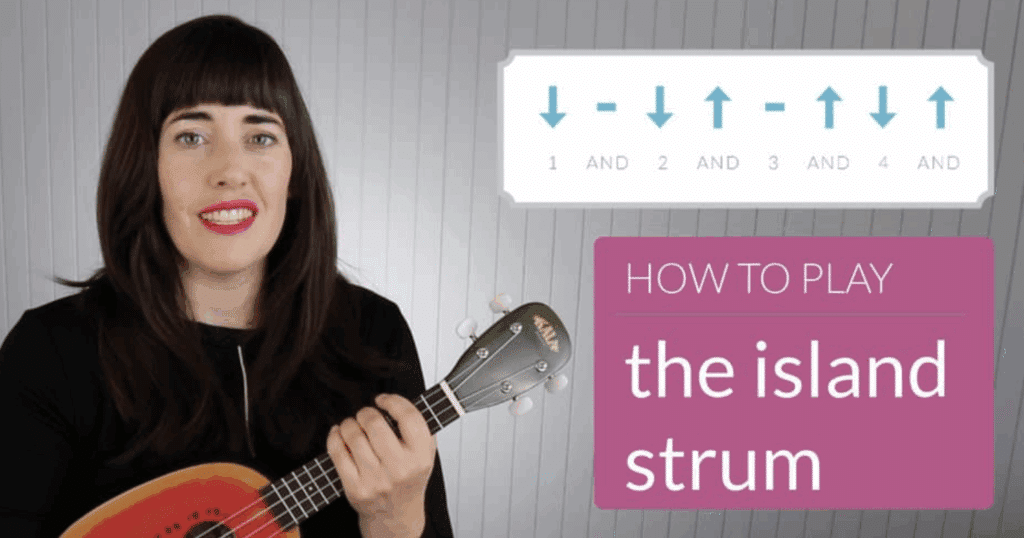
While it is important to get the basics correct, you can also show them the Island or Calypso strum. This is the most famous ukulele strumming pattern and a favorite among beginners. It brings an upbeat feel to the playing. If you only teach one “more advanced” strumming pattern, this should be it.
It goes as follow: D-D-U-U-D-U. You can count 1 2 & & 4 & (down on beats 1 and 2, up on the “&” after 2, down-up on 4). Say the words “Down, Down-Up, Up-Down-Up” as you strum. Loop the pattern until it becomes second nature. Start slow, then gradually build speed. The Island Strum fits “Riptide” by Vance Joy perfectly, one of the most popular beginner ukulele songs worldwide.
To get a real deep dive into strumming patterns, with sound examples, check out the ultimate strumming guide I wrote.
3. Switching Chords and Simple Songs
3.1 Chord transitions
Switching chords is often the trickiest part for beginners. Kids may want to hold onto a chord rather than transition. To help them, create some “hop” or “jump” excercises. For example, while holding a C chord, ask them to left their fingers and land in a Am chord in one smooth move with no pause.
Pratice this without strumming at first, just moving the fingers. Do this with only two chords. Some common transitions are: C to Am, C to F, C to G and basically everything in between. Let them master this switching gradually before it becomes overwhelming. Encourage minimal finger movement making sure they keep their fingers close to the fretboard and not lift too high.
3.2 First songs
Pick easy, child-friendly songs with 2 or 3 chords. The list below is a good starting point. Familiarity helps a lot! Go over each chord in the song before starting as well as the transitions. Discuss which strumming pattern to use (down strums work almost everywhere). Let them strum along slowly at first. Celebrate small successes, getting through a verse without stop, getting the strum right, nailing a transition…
| Song | Link | Chords |
|---|---|---|
| Twinkle Twinkel Litte Star | link | C, F, G, G7 |
| Are You Sleeping / Frère Jacques | link | One chord G version |
| Old MacDonald Had a Farm | link | C, F, G |
| Riptide | link (transposed -1) | Am, C, G |
| Three Blind Mice | link | C, G |
| Somewhere Over the Rainbow | link | Am, C, Em, F, G (E7 optionall) |
| Wheels On The Bus | link | C, G |
4. Adding Complexity: More Chords and Rhythms
Once they can do a few chords and strum steadily, you can:
- Introduce new chords gradually. I’d suggest rounding out with D, E and Em, but a particullary good tip is to let them pick song (or songs) they like and see what chord (or chords) it uses. It typically motivates them more to learn that particular chord since it will have a distinct goal.
- Teach more advanced strumming patterns such as syncopated, reggae…
- Show how to add some percussive effects with palm muting or chunking.
- Encourage dynamics such as the effect and feel of strumming soft versus strong.
- “Gamifying” the experience is typically very successful. Think about chord name races, fretboard hide and seek, circle of a chord…
5. Motivation, Games, Creativity & Performance
One of the biggest challenges when teaching kids ukulele really isn’t the chords or strumming, but it’s keeping them motivated. They are curious and full of energy, but attention spans can be short (don’t ask me how I know). That’s why I always try to make learning feel like play rather than work. If they’re having fun, progress will follow almost automatically. That is however more easily said than done. Here are a few tips to help you.
Keep it short and rewarding
For most young beginners, 10 to 30 minutes each or every other day is more than enough. It’s long enough to learn something new but short enough to stay focused. Make sure each session ends on a small win, never end with negative energy. Play through a short song, learn a new chord or simply strumming in rhythm without stopping are all good finishers. Finishing on a success builds confidence and excitement for the next session. Kids should leave the instrument feeling proud, not frustrated. It’s better to cut a lesson short with a positive vibe.
Choose songs they actually enjoy
It might sound obvious, but this makes a huge difference! If a kid loves Disney songs, Minecraft themes, or Taylor Swift, pick that. The beauty of the ukulele is that the instrument can be as easy or as difficult you want. Almost any tune can be simplified into a few easy chords. Using the transposition feature on UkuTabs can be a huge help with this. This allows you to change the key of the song to find chords that are already known. While you should still guide them to songs that are feasible and worth learning, make sure to also let them pick a song once in a while.
Turn practice into a game
Practice doesn’t have to be repetitive or boring. As mentioned before, there are tons of creative ways to gamify ukulele lessons. They work because they sneak learning into something they are familiar with, they are having fun.
- Chord Bingo: Draw a grid with chord names and let them mark off the ones they can play cleanly.
- Chord Race: See who can switch between two chords the fastest (great for group lessons).
- Ukulele Simon Says: Instead of physical actions, give musical instructions like “play the C chord,” “strum twice,” or “freeze!”
- Song Puzzle: Cut up the lyrics of a simple song and ask them to arrange the parts in the right order as they play.
- Play the tuning game mentioned at the start to train their hearing.
Encourage creativity
Once they’ve got a few chords down, why not let them write their own song? The song doesn’t need to make sense or sound good, but encourage them to be creative. You can help them along a bit by suggesting a them. For example a song about their pet or what they had for lunch. Music is a form of self-expression, make them aware of that, let them improvise.
Build confidence through small performances
Performing is incredibly powerful. Encourage them to show off what they’ve learned. You can call it a mini-concerts rather than a performance to take some of the pressure away. Celebrate every milestone, no matter how small.
Sample 6-Lesson Plan (for a beginner child)
Here’s a rough outline you can adapt to your planning. From there expand gradually and finetune to your kid or student. Add more chords, more strumming patterns, more song variety…
- Lesson 1: Parts, posture, tuning, open strum, C chord
- Lesson 2: Strumming downstroke, reinforcing C, start chord switch practice
- Lesson 3: Add Am or F chord, strum C → Am → C, simple song
- Lesson 4: Introduce G chord, practice switching among three chords
- Lesson 5: Introduce strumming pattern (D-U) or rhythmic variation, play a 3-chord song
- Lesson 6 : Game day / review / mini performance of a song
Some quick Troubleshooting & Tips
- Sore fingers: Definitely young untrained fingers can get sore quickly. Change your schedule to short, frequent practice.
- Muted strings / buzzing sound: Check the ukulele first, then check finger curvature, they should use the tip of the finger and check the placement of the finger, close to the fret but not on top of it.
- Kids losing focus: Alternate between playing, listening, singing, games. Learn songs they want, let them write songs, play games.
- Chord diagram difficulty: Don’t be afraid to simplify some chords. Teach partial chords and use that as a stepping stone.
- Tuning confusion: Use a visual tuner such as the one here on UkuTabs showing which peg to turn for which string.
Some Frequently Asked Questions
Many professional ukulele teachers recommend starting around age 6 as younger children might struggle with coordination or attention. It depends however greatly on the child. You can introduce the ukulele at an earlier age as a “toy” to get the kid already familiar with it.
With consistent practice, the basic chords are taken up very quickly and 2 or 3 chord songs can be played after only the first lessons.
It is much better to practice in short daily or every-other-day sessions than one long session every week.
While it depends on the interest of the child, initially, focus on playing, listening, and having fun. Theory (scales, chord structure) can come later.
Stop pushing! Back off a little bit and just play together, pick songs they like, make it fun again. If after some time they still don’t enjoy it, that’s okay.