Free chord library

Ukulele Chord Diagrams

Look up any ukulele chord on any tuning. This free chord library covers 22 chord qualities (triads, sevenths, sixths, suspended, ninths, and added-tone shapes) across standard high-G, low-G, baritone (DGBE), and D-tuning. Pick a root and a chord type, and the tool generates every playable fingering on the fly, ranks them easiest first, and shows up to 48 alternate voicings per chord. Each one plays back with realistic plucked-string audio, mirrors instantly for left-handed players, and copies to a shareable link.

Free ukulele chord library. 22 chord qualities, 4 tunings, up to 48 voicings each. Tap any chord to hear it, copy a link to share it.

Features
  • 100% free
  • 22 chord qualities
  • 4 tunings
  • Audio playback
  • Lefty mode
Tuning
Lefthanded
Root note
Chord type

Most used C chord variations

The six C-rooted chord shapes you'll meet most often in pop, folk, worship, and singer-songwriter material: major, minor, dominant 7, minor 7, major 7, and sus4. Together they cover roughly nine out of ten songs in any given key. Click any diagram to load it into the main workspace above and step through its alternate voicings.

How to read a ukulele chord diagram

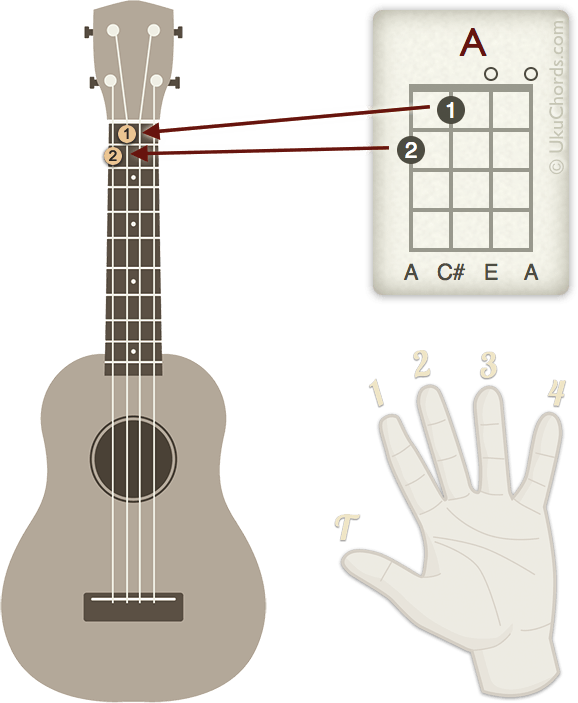
Annotated ukulele chord chart showing finger positions for an A major chord

A ukulele chord diagram is a top-down picture of the first four or five frets of the neck. The four vertical lines represent the four strings. In standard tuning, reading left to right, those are G, C, E, and A. The horizontal lines are the frets, and the thick bar across the top is the nut, the piece of bone or plastic that separates the open strings from the fretted positions.

Dots show where to press your fingers, and the number inside each dot tells you which finger to use: 1 for index, 2 for middle, 3 for ring, and 4 for pinky. A hollow circle above a string means play that string open with no finger touching it. An × means mute the string or skip it entirely when you strum.

If a number appears next to the diagram (for example 5fr), the diagram is shifted up the neck and the top fret shown is actually the fifth fret rather than the first. That's how higher-position and barre chords get drawn without forcing a long, thin diagram.

The example pictured here is an A major chord. Press the G string at the second fret with your middle finger and the C string at the first fret with your index finger. The little o symbols on the E and A strings tell you to let those ring open. For a longer walkthrough with audio, see the how to read ukulele chord diagrams guide.
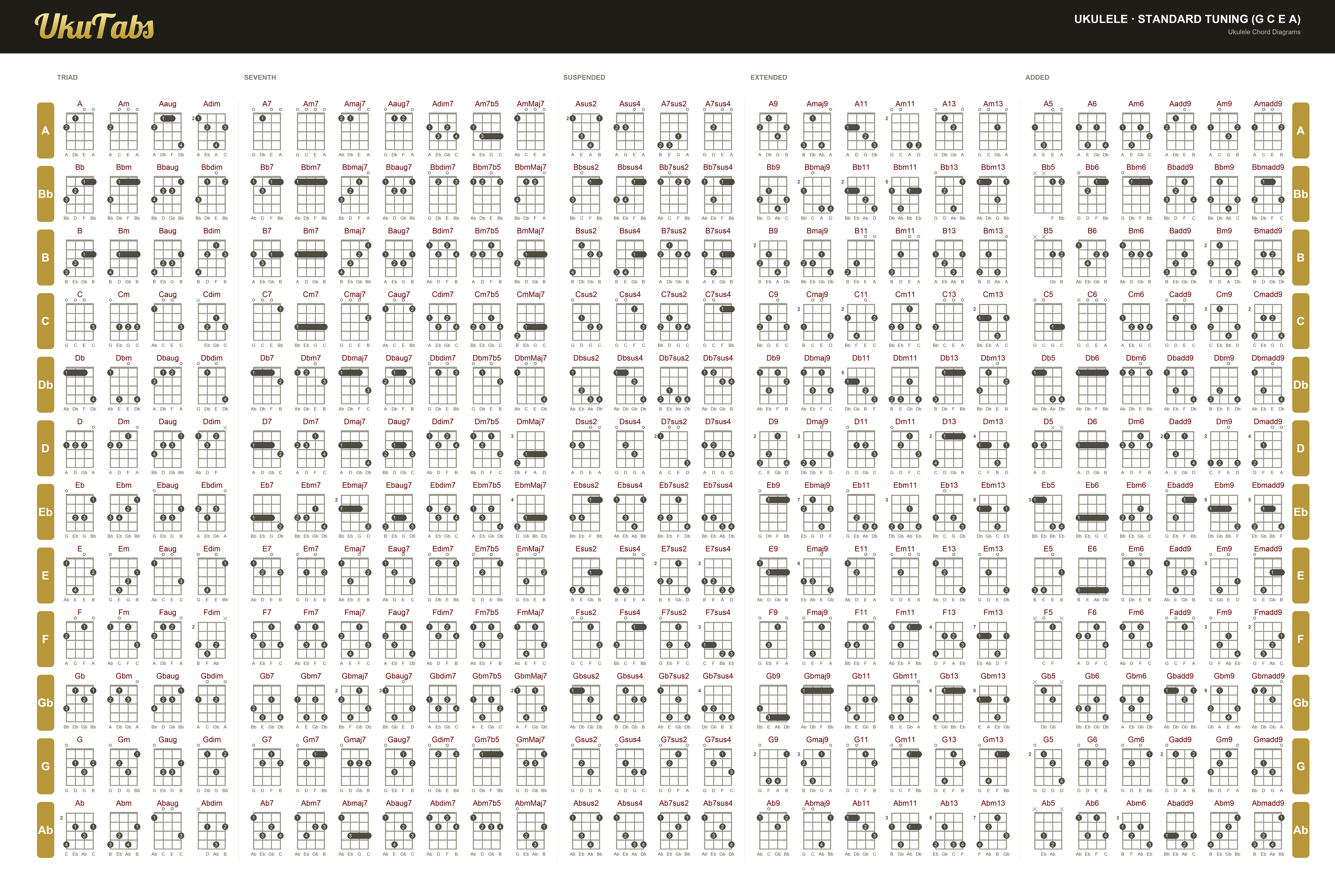
All C chord variations

How ukulele chord names work

Chord symbols look cryptic at first, but they follow a tight pattern. The capital letter is the root note (C means a chord built on C, F# means a chord built on F sharp). Everything after that describes what gets stacked on top: the chord's quality and any extra notes drawn from the scale. Numbers point to scale degrees counted from the root, so a 7 is the seventh note above the root, a 9 the ninth, a 13 the thirteenth. Letters like m, dim, aug, and sus tweak the underlying triad.

m
MinorCm = C minor
7
Dominant seventhThe bluesy one (C7)
maj7
Major seventhCmaj7, a soft jazzy chord
m7
Minor seventhCm7, mellow and warm
dim
Diminished triadTense, unresolved sound
dim7
Diminished seventhStack of minor thirds
aug
Augmented triadRaised fifth, dreamy
m7b5
Half-diminishedMinor 7 with flat 5, jazzy
sus2
Suspended 2ndThird replaced by the 2nd
sus4
Suspended 4thThird replaced by the 4th
6
SixthMajor triad + sixth on top
6/9
Sixth + ninthLush jazz colour
add9
Added ninthTriad + 9th, no 7th
9
Dominant ninthC7 with a ninth on top
m9
Minor ninthCm7 with a ninth on top
maj9
Major ninthCmaj7 with a ninth on top
5
Power chordJust the root and the 5th

Free downloadable charts

The official UkuTabs chord charts in two print-ready formats: a large wall poster and a portable A4 booklet. Free for personal use. Please don't redistribute or sell them.

Tuning
Lefthanded

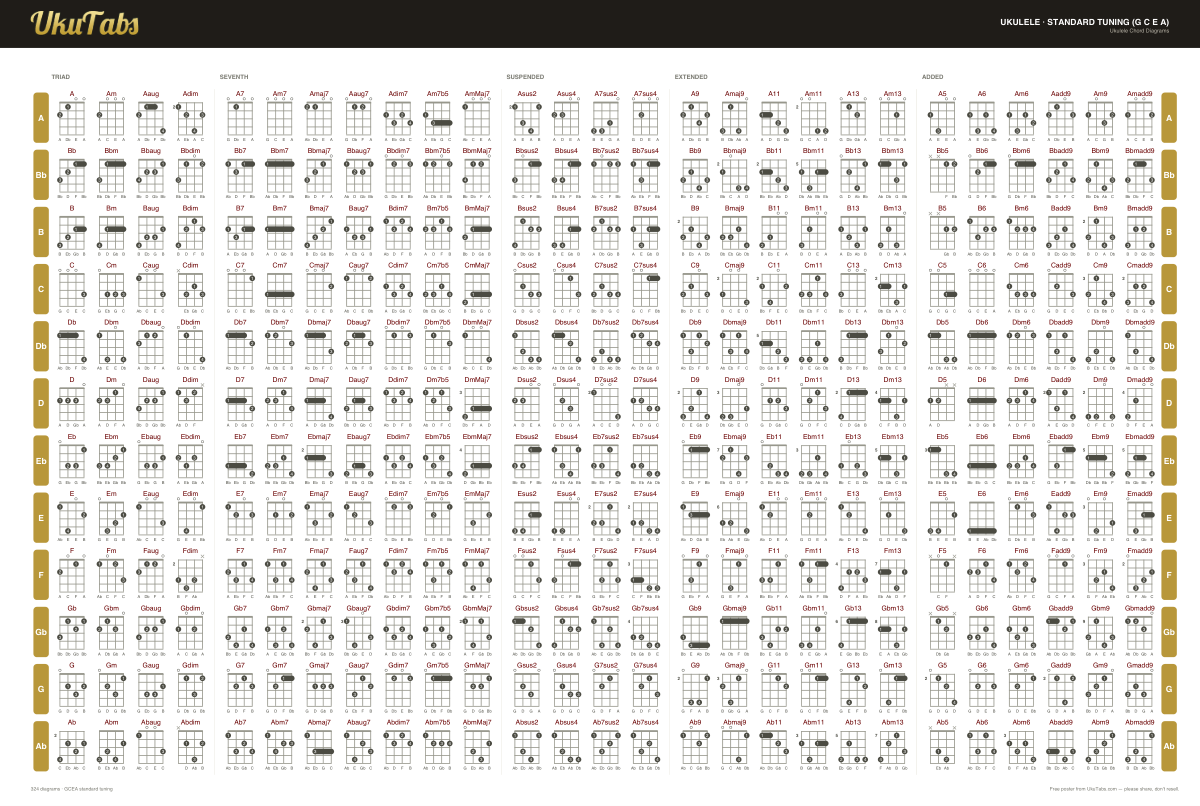
A2 Poster

Preview of the UkuTabs ukulele chord chart wall poster

High-resolution print poster in A2 size (594 × 420 mm, or 16.5 × 23.4 in). Hang it on the wall above your practice spot, or open it on a tablet next to your music stand. Every essential ukulele chord shape on a single sheet.

Download PNG (300 DPI) Download poster PDF

A4 PDF Booklet

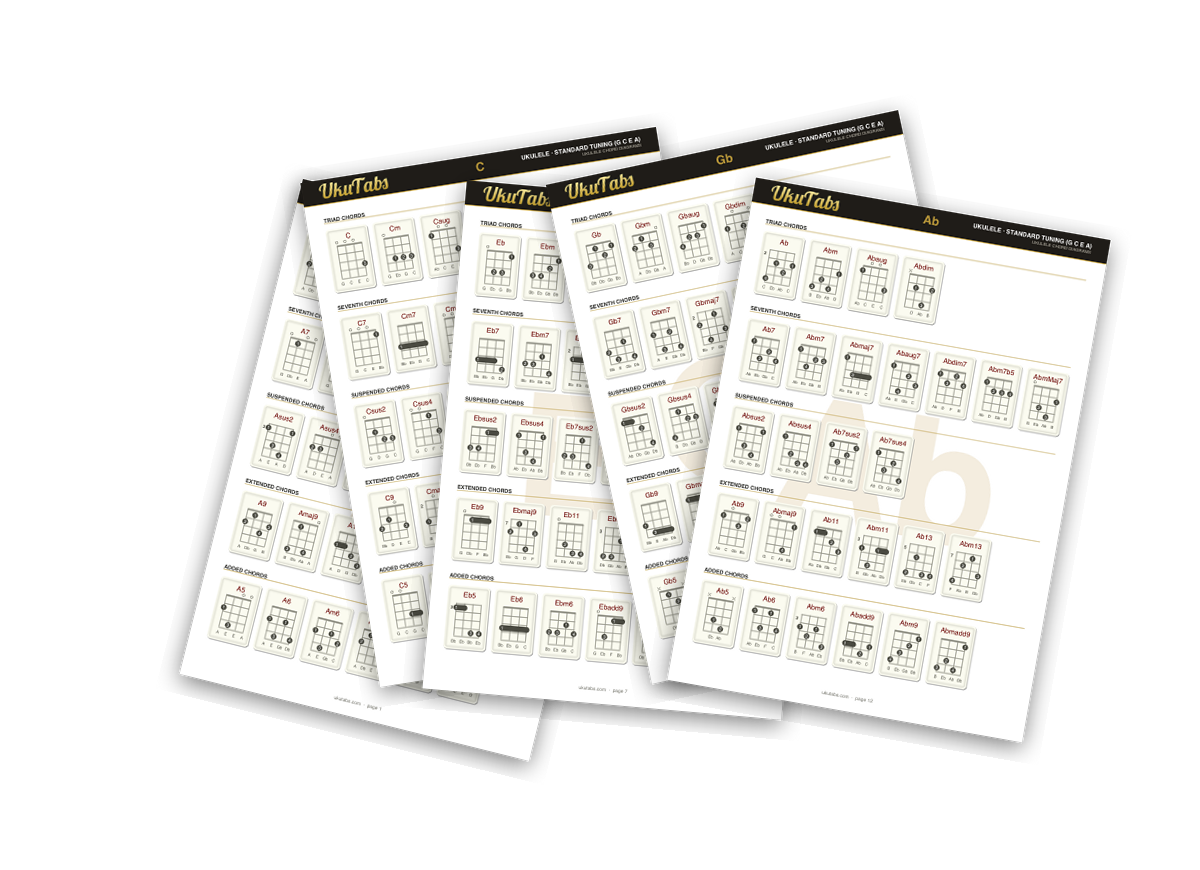
Preview of the UkuTabs A4 ukulele chord chart booklet

Multi-page A4 PDF in press quality. Same chord coverage as the poster, laid out for printing on standard paper. Spacious lays out one root per page with bigger diagrams. Dense fits two roots per page to save paper.

Download dense PDF (6 pages) Download spacious PDF (12 pages)
Do not sell my data