The UkuTabs online ukulele tuner gets your ukulele in tune fast. No app, no download, no sign-up. Pluck a string and your device's microphone detects the pitch with professional accuracy, guiding you visually toward each string's target note. Defaults to standard 'C' tuning (gCEA), the most common ukulele tuning. One click switches to low-G (GCEA), baritone (DGBE), English D, or any of ten preset tunings. Prefer to tune by ear? Tap a peg on the visual ukulele to hear that string's reference note. Left-handed players: flip the layout in a single tap.
Get your ukulele in tune fast. Pluck a string and your mic detects the pitch. Or tap a peg to hear the reference note. Defaults to standard gCEA; switch to low-G, baritone, or any of ten presets.
Features
100% freeFree
Works in your browserIn-browser
Microphone or by earMic or by ear
Audio never leaves your devicePrivate
Tune your ukulele
Tuningor
Tune with your microphone
-
- Hz
Tap "start listening" to tune by mic, or "tone" to tune by ear. Tap a string above to lock it as your target. Audio never leaves your device.
Tune by ear
Settings
Autoplay
Lefthanded
CEGA
Trusted by ukulele players around the world since UkuTabs launched in 2012.
This mic tuner runs a YIN pitch-detection algorithm with median-filter smoothing
and variance-based stability scoring. It's the same approach used by pro studio tuners,
adapted for the ukulele's bright re-entrant timbre. Everything runs in your browser:
no app to install, no audio uploaded, no account needed.
How to tune a ukulele in 60 seconds
Tuning is the first habit every ukulele player picks up. Whether you use the microphone tuner above or your ear, the routine is the same: pick the right tuning, match each string to its target note, and lock it in by turning the peg. Most ukuleles use standard C tuning (g-C-E-A); baritones use D-G-B-E.
With a little practice the whole process takes under a minute. Fresh strings often need two or three passes before they hold pitch, so don't worry if it feels slow at first. That's completely normal.
1
Which tuning should I use?
Most soprano, concert, and tenor ukuleles use standard C (g-C-E-A), and that's the default in the tuner above. Baritones use D-G-B-E. Low-G is the same C tuning with the G string an octave lower. Not sure what you have? Leaving the default works for almost everyone.
2
How do I match the right note?
Tap start listening and pluck any string. The tuner reads the note and shows whether you're flat (needle leans left) or sharp (needle leans right). No microphone? Tap a string in the by-ear card above to hear the target note and match it by ear.
3
How do I lock it in?
Turn the peg slowly until the needle settles on center. A green check appears after about a second to confirm you're in tune. Repeat for the other three strings, then run through all four once more. Tuning one string shifts the tension on the others, so a second pass is normal.
Ukulele tunings explained
Most players spend their entire ukulele life in standard C tuning, and there's nothing wrong with that. But the ukulele has a small family of tunings, each with its own sound and history. Here's a quick overview of what each one is for, who plays it, and which body size it suits best.
Standard C (high-G)
Most common
g - C - E - A
The classic ukulele tuning, sometimes called C tuning or re-entrant tuning. The G string is tuned higher than the C string, which gives the ukulele its bright, jangly character. If you're new to the instrument, this is almost certainly what you have.
Used by: soprano, concert, and tenor ukuleles. The default on virtually every uke sold today.
Standard C (low-G)
Fingerpicking
G - C - E - A
Same C tuning, but with the G string an octave lower than the C. You gain one extra octave on the low end, which opens up fingerpicking, melody playing, and solo arrangements. Many tenor players prefer the fuller, more guitar-like sound.
Used by: tenor ukuleles most often. Requires swapping the G string for a wound or thicker fluorocarbon version.
Baritone
Like a guitar
D - G - B - E
The baritone ukulele is tuned identically to the top four strings of a guitar. If you already play guitar, your chord shapes transfer over directly, with no relearning needed. The sound is mellower and lower than a standard ukulele.
Used by: baritone ukuleles only. Don't use these strings on a soprano, concert, or tenor.
D-tuning & slack-key
Alternate
D-tuninga - D - F♯ - B
Slack-keyg - C - E - G
D-tuning is standard C shifted up two frets. It was popular in the early 1900s and is still favoured by some players for its sweeter, ringier tone. Slack-key drops the A string a whole step to match the high g, which is lovely for Hawaiian-style fingerpicking. The preset dropdown above covers both.
Used by: vintage and Hawaiian players, fingerpickers, and anyone exploring beyond standard.
Which tuning fits my ukulele size?
If you're not sure what your ukulele is tuned to, body size is usually the clue. Almost every uke ships in the tuning marked below.
Body size
Length
Default tuning
Also seen
Soprano
~53 cm / 21"
Standard C (high-G)
D-tuning (aDF#B)
Concert
~58 cm / 23"
Standard C (high-G)
Low-G
Tenor
~66 cm / 26"
Standard C (high-G)
Low-GD-tuning
Baritone
~76 cm / 30"
Baritone (DGBE)
G-tuning (GCEA, low)
Reference frequencies
Target frequencies for the six most common tunings. The tuner above handles all of these automatically. This table is here for when you want to verify against a piano, another tuner, or out of plain curiosity.
Tuning
4th string
3rd string
2nd string
1st string
Standard C (high-G)
G4392.00 Hz
C4261.63 Hz
E4329.63 Hz
A4440.00 Hz
Standard C (low-G)
G3196.00 Hz
C4261.63 Hz
E4329.63 Hz
A4440.00 Hz
Baritone (D-G-B-E)
D3146.83 Hz
G3196.00 Hz
B3246.94 Hz
E4329.63 Hz
D-tuning (aDF♯B)
A4440.00 Hz
D4293.66 Hz
F♯4369.99 Hz
B4493.88 Hz
Slack-key (gCEG)
G4392.00 Hz
C4261.63 Hz
E4329.63 Hz
G4392.00 Hz
Half-step down
F♯4369.99 Hz
B3246.94 Hz
D♯4311.13 Hz
G♯4415.30 Hz
How do I tune a ukulele without a tuner?
Three methods to choose from, depending on what you have to hand. Tap a tab below to switch between them.
Tune by ear (relative tuning)
No microphone? You can tune all four strings to each other using fretted reference notes. This gets the ukulele in tune with itself, which is perfect for playing alone. If you plan to play with others at concert pitch, anchor the first string to a known reference first, like a piano A4 (440 Hz).
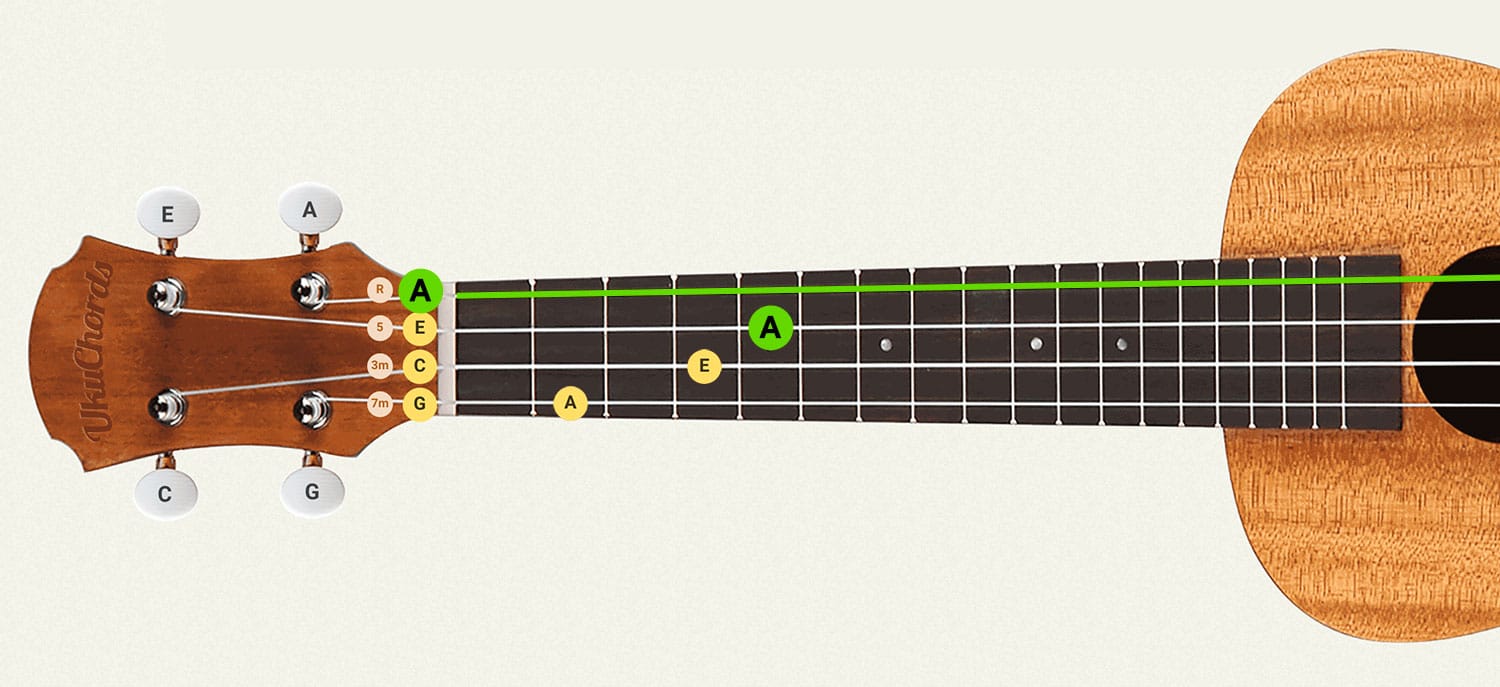
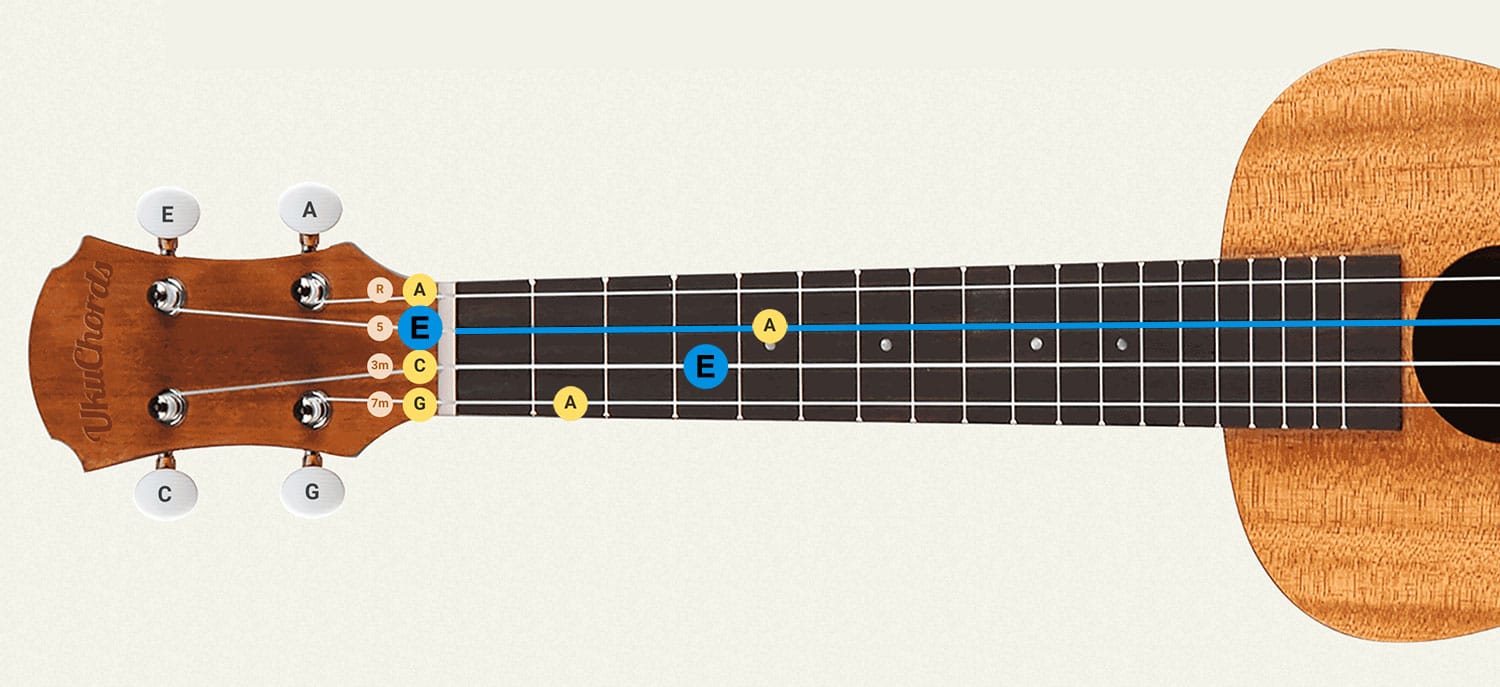
1. Start by tuning the 1st string (A) to a reference: a piano note (440 Hz), the by-ear card above, or another tuned instrument. Once your A is set, hold down the 5th fret of the 2nd string (E). That note is also an A. Adjust the 2nd string's peg until the two notes sound identical.
2. Hold down the 4th fret of the 3rd string (C). That note is an E. When you pluck the open 2nd string (E), the two should sound the same. Adjust the 3rd string's peg until they match.
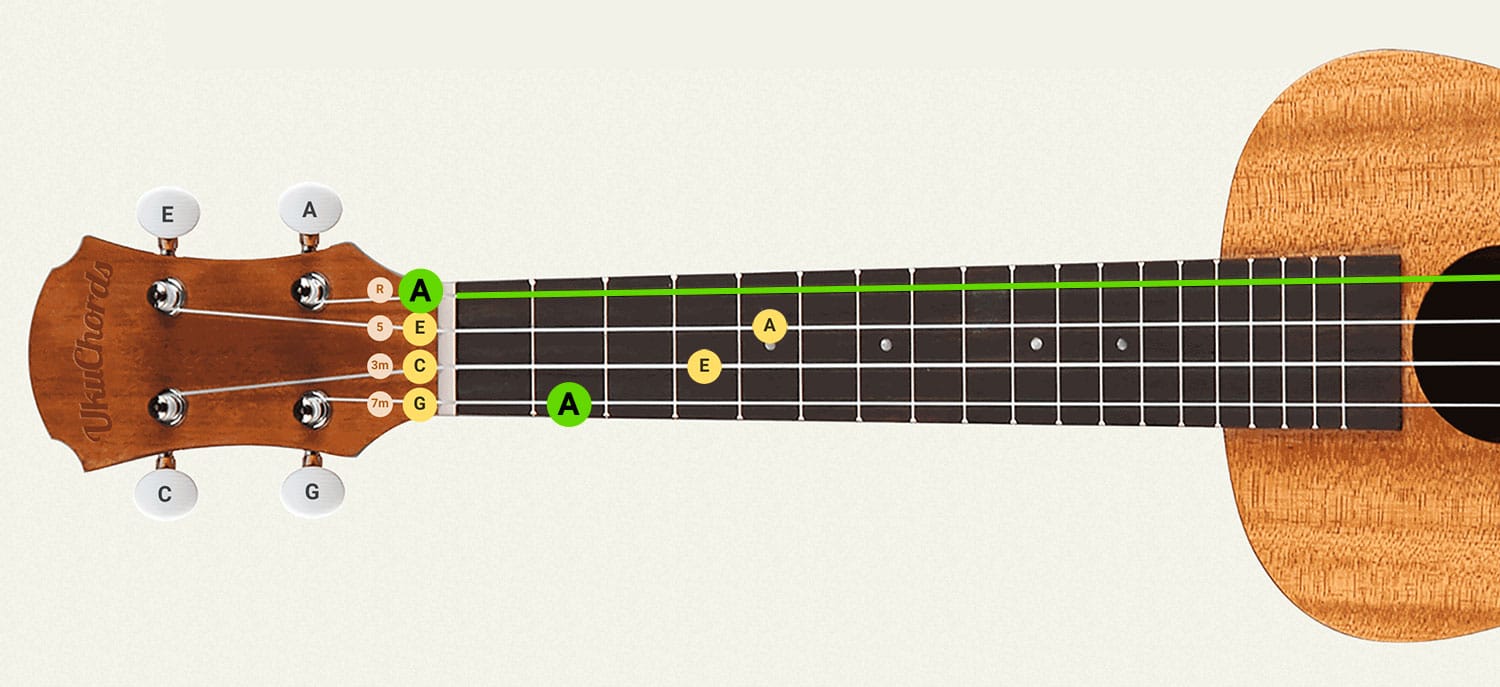
3. Finally, tune the 4th string (G). The method depends on whether you have a high-G (standard re-entrant) or low-G (linear) ukulele. Pick yours below:
Hold down the 2nd fret of the 4th string (g). That note is an A. Match it to the open 1st string (A), and you're done. Your ukulele is in tune with itself.
Hold down the 5th fret of the 4th string (G). That note is a C. Match it to the open 3rd string (C), and you're done. Your low-G ukulele is in tune with itself.
Tune from a piano
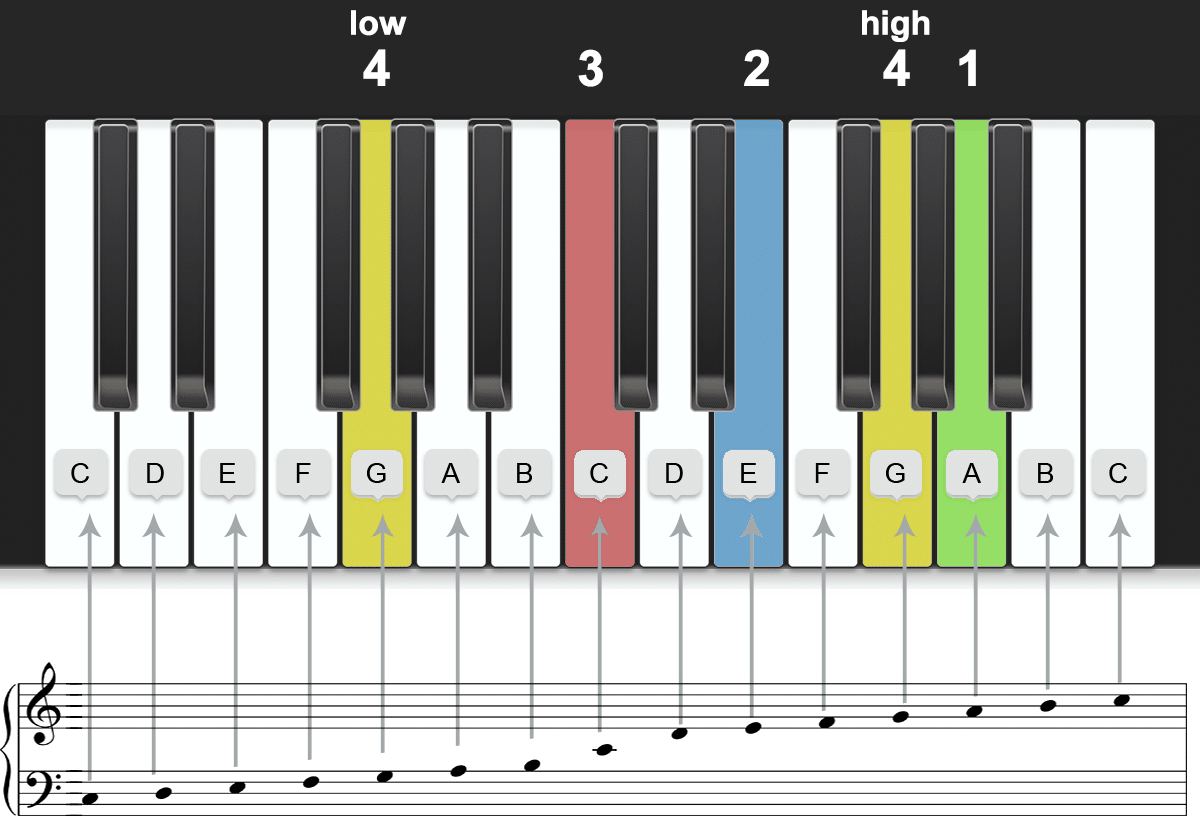
A piano or any keyboard makes a perfect tuning reference, since its strings are tuned to standard concert pitch (A4 = 440 Hz). Play G, C, E, and A in turn and match each open ukulele string by ear.
Middle C sits one white key to the left of the pair of black keys near the centre of the keyboard. From middle C, count up four white keys to find E, and nine to find A. Count down five keys to find G, or just use the G above middle C for standard high-G tuning.
For low-G tuning, play the G one octave below middle C instead.
Tune with a guitar
If you have a tuned guitar within reach, you don't need a separate tuner at all. The method depends on the size of your ukulele.
Standard ukulele
Capo the guitar on the 5th fret
A guitar's top four strings are tuned D, G, B, and E. Capo on the 5th fret and those same strings now sound G, C, E, and A, which is exactly standard ukulele tuning. Pluck each capoed guitar string and match the corresponding open ukulele string.
Guitar 4th @ 5→Uke 4th (G)
Guitar 3rd @ 5→Uke 3rd (C)
Guitar 2nd @ 5→Uke 2nd (E)
Guitar 1st @ 5→Uke 1st (A)
Baritone ukulele
No capo needed
Baritone ukuleles tune D, G, B, and E, which is identical to the top four strings of a guitar. Just play each open guitar string and match the corresponding open baritone string.
Guitar 4th (D)→Bari 4th (D)
Guitar 3rd (G)→Bari 3rd (G)
Guitar 2nd (B)→Bari 2nd (B)
Guitar 1st (E)→Bari 1st (E)
Bonus: a chromatic guitar tuner (clip-on or pedal) works for a ukulele too. Set it to chromatic mode and tune to the notes above instead of standard guitar EADGBE.
Frequently asked questions
Short answers to the questions ukulele players ask most about tuning.
Is this online ukulele tuner free?
Yes, completely free. No sign-up, no app to install. The tuner runs entirely in your browser, on whatever device you're already holding.
How does the microphone tuner work?
It uses the YIN pitch-detection algorithm (de Cheveigné and Kawahara, 2002), running directly in your browser. When you pluck a string, the tuner reads its fundamental frequency, compares it to the target note, and shows you how far off you are in cents.
Audio never leaves your device. There's no upload, no recording, and no analytics on what you play.
Does this tuner work on iPhone and Android?
Yes. The tuner works on any phone, tablet, or laptop with a modern browser (Safari, Chrome, Firefox, or Edge). Your browser will ask for microphone permission the first time you tap start listening.
What is standard ukulele tuning?
Standard tuning for soprano, concert, and tenor ukuleles is G-C-E-A, also called C tuning. The G can be high (re-entrant, which produces the bright, jangly ukulele sound) or low (a deeper, more melodic range).
Baritone ukuleles tune D-G-B-E, the same as the top four strings of a guitar.
What's the difference between high-G and low-G?
High-G (G4 = 392 Hz) sits above the C string. This is re-entrant tuning, and it produces the classic ukulele jangle.
Low-G (G3 = 196 Hz, one octave lower) gives the ukulele a deeper range. It's useful for fingerpicking and solo melodic playing. To switch, swap your G string for a wound or thicker fluorocarbon version.
How often should I tune my ukulele?
Every time you play, ideally. Brand new strings need re-tuning every few minutes for the first few days as they stretch and settle. After that break-in period, a check before you play and another in the middle of a long session is usually enough.
Temperature and humidity changes (like moving from indoors to outdoors) also pull a ukulele out of tune quickly.
Why does my new ukulele keep going out of tune?
Fresh nylon or fluorocarbon strings stretch for three to seven days of regular playing. During this break-in period, expect to re-tune every time you pick up the instrument. It's completely normal.
You can speed up the process by gently stretching each string by hand between tunings: pull it away from the fretboard, then re-tune.
Can I tune my ukulele without internet?
The first load requires internet, but the tuner keeps working offline after that, browser permitting. You can also tune by ear using the string player above: tap each note to hear it and match by ear.
Tone mode vs microphone mode: which should I use?
Microphone mode listens to your ukulele and guides you peg by peg. It's faster and more precise once you're comfortable with it.
Tone mode plays the target notes back to you so you can match them by ear. It's useful when the room is noisy, when you're learning to hear pitch, or when the microphone isn't an option.
The tuner won't lock onto my G string: what gives?
Some G strings, especially older or thicker fluorocarbons, have strong overtones that can confuse pitch detectors. If your G keeps jumping or won't lock in, tap the G chip in the dial section to lock the tuner onto that string.
The tuner stops auto-detecting and focuses only on G. The needle still works exactly the same way.
Can I tune my ukulele with a guitar tuner?
Yes. Any chromatic tuner reads pitch regardless of the instrument. Set it to chromatic mode (not guitar mode) and tune to G4-C4-E4-A4 for standard high-G, or G3-C4-E4-A4 for low-G. Baritone ukuleles tune D3-G3-B3-E4, which is identical to the top four strings of a guitar, so no chromatic mode is needed.
How do I tune a ukulele with a guitar?
Capo your guitar on the 5th fret and pluck the top four strings. They now sound G, C, E, and A, the same as standard ukulele tuning. Match each open ukulele string to the corresponding capoed guitar string. For a baritone ukulele no capo is needed: open guitar D-G-B-E matches baritone tuning directly.
There are four main types. Clip-on tuners clamp to the headstock and sense vibration through the wood, which makes them great in noisy rooms. Pedal and rack tuners are used for performance and studio recording. Tuning apps run on your phone and use the device microphone. Online tuners like this one run in your browser with nothing to install. For everyday practice, an online or app tuner is usually all you need.
Why won't my ukulele stay in tune?
A ukulele can drift out of tune for plenty of reasons: fresh strings stretching, temperature and humidity swings, a loose tuning peg, or a misaligned nut. The good news is that most of them have a quick fix once you know what to look for.
Below are the three most common problems and how to solve them. Anything weirder is usually a setup issue, worth a thirty-minute trip to a luthier.
Tuning slips back
Older ukuleles, or ones that weren't set up properly, can have loose tuning heads. Tighten the small screws on top of the tuning machines (soprano ukuleles especially) until the pegs turn smoothly but not too freely.
Strings buzz when you play
Buzzing is usually a setup issue: bridge height, nut wear, or fret action. A luthier can fix most cases in about half an hour.