
Cómo rasguear un ukelele
 de Jonas
Para rasguear el ukelele, barre hacia abajo sobre las cuatro cuerdas con la uña del índice, justo donde el mástil se une al cuerpo, y deja que el movimiento salga de una muñeca suelta y no de todo el brazo. Rasguea hacia arriba con la yema de ese mismo dedo. Cuando eso te salga natural, añade un patrón como el rasgueo isleño.
- Lo básico del rasgueo
- Leer la notación de rasgueo
- Los 18 patrones con audio
- El rasgueo isleño
El rasgueo es lo que convierte los acordes en una canción y es más simple de lo que parece. Toda la técnica se reduce a tres cosas: una muñeca relajada, el punto correcto de las cuerdas y un patrón constante. Aquí tienes cómo conseguir las tres, y después dieciocho patrones para practicar, cada uno con flechas que puedes reproducir.
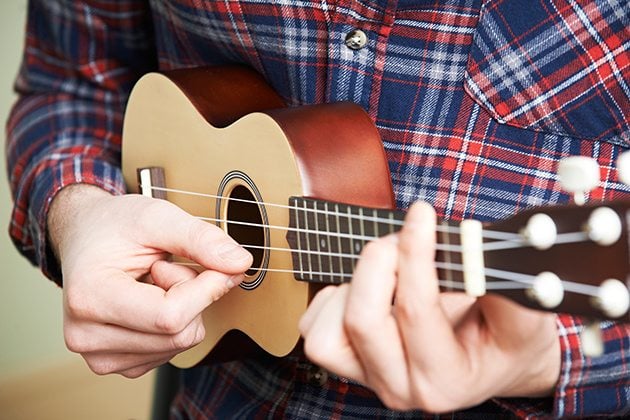
Lo básico para rasguear tu ukelele
Empieza con la posición básica de la mano, que es un puño suelto. Rasguea con el índice de la mano derecha, con la uña hacia abajo. Al rasguear hacia abajo deberías golpear las cuerdas con la uña. Al rasguear hacia arriba, con la yema del dedo. Es importante usar la muñeca y no toda la mano. Usar toda la mano cansa enseguida.
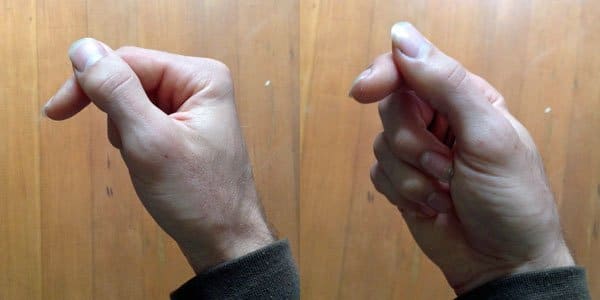
Cuando yo empecé a tocar el ukelele lo hacía de otra forma. Juntaba la punta del pulgar y del índice como si sujetara una púa. Rasgueaba hacia abajo con la uña del índice y hacia arriba con la punta del pulgar. Quizá sea por mi pasado guitarrero, pero al principio me resultaba una forma más fácil de rasguear. También conviene asegurarse de rasguear en el punto correcto. Rasguear demasiado cerca del puente o demasiado arriba del mástil produce un sonido apagado.
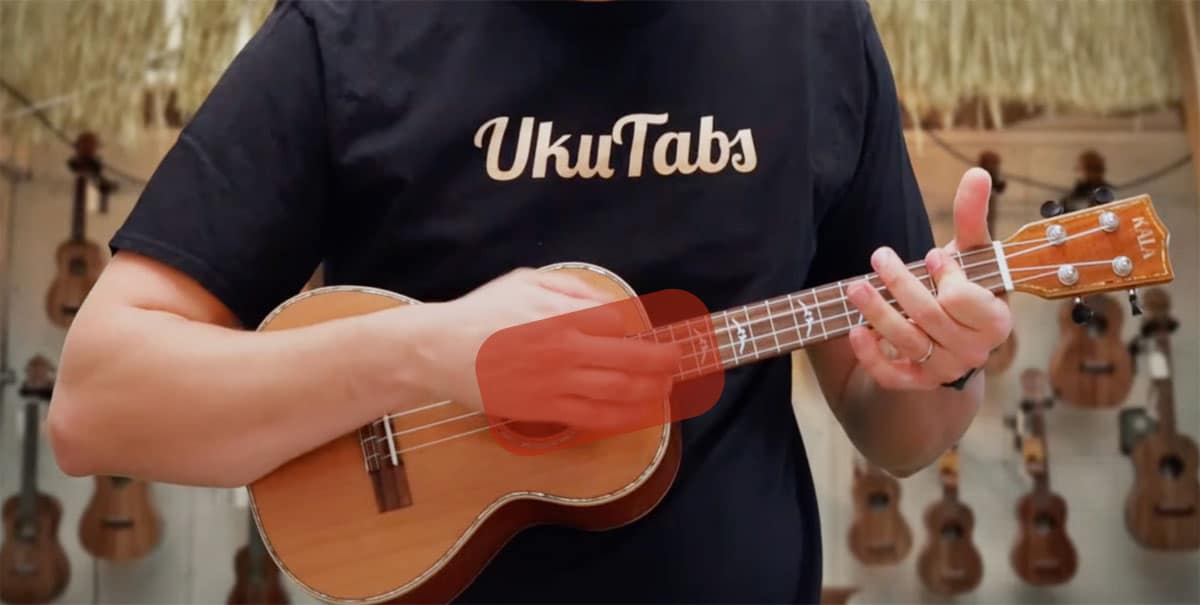
He comprobado que el mejor punto para rasguear el ukelele cambia de un instrumento a otro, pero está alrededor de la zona donde el mástil se une al cuerpo (mira la zona roja de abajo).
Practica el rasgueo de cualquiera de las dos formas simplemente subiendo y bajando. Cuando lo domines, pasa a la sección avanzada. Y cuando tu rasgueo funcione en piloto automático podrás empezar a cantar encima. Aquí tienes cómo cantar y tocar a la vez.
Avanzado
Cuando el arriba-abajo básico te resulte cómodo, puedes empezar a darle forma a un ritmo. Cada canción tiene su propio patrón de rasgueo, y se construye manteniendo el mismo movimiento constante de subida y bajada pero esquivando las cuerdas en ciertos golpes. Por ejemplo, prueba abajo, arriba, esquiva, abajo: mantén la mano en movimiento todo el rato, pero deja que toque las cuerdas solo en los golpes que quieres oír. Practica despacio, idealmente con un metrónomo a unos 60 pulsos por minuto. Acelera solo cuando el patrón salga parejo. Mantener la mano en movimiento en los golpes esquivados es lo que sostiene tu timing.
Notación de rasgueo
Los patrones de rasgueo se escriben como una fila corta de letras que indican hacia dónde se mueve tu mano en cada tiempo. No publico el rasgueo exacto de canciones concretas con derechos de autor, pero los patrones generales y la notación de abajo funcionan en miles de ellas. Esto es lo que significa cada símbolo.
- d : rasgueo hacia abajo
- u : rasgueo hacia arriba
- – : pausa o rasgueo esquivado, es decir, mueves la mano arriba o abajo sin tocar las cuerdas. Estos te dan el timing de los rasgueos.
- x : un chnk. Rasgueas hacia abajo y sigues el movimiento hasta que la parte baja de la mano aterriza en las cuerdas, creando un sonido de “chnk”.
- (d) o (u) : un rasgueo muteado hacia abajo o hacia arriba. Rasgueas normal pero con los dedos de la mano de los trastes apoyados en las cuerdas para que no resuenen. Suena como un chnk pero puedes hacerlo en ambas direcciones.
- D o U : las mayúsculas significan que el rasgueo va acentuado, así que dale con más ganas.
Patrones de rasgueo
| # | Patrón | Ideal para |
|---|---|---|
| Rasgueos de arranque | ||
| 1 | d d d d | El primerísimo rasgueo (todo hacia abajo) |
| 2 | d u d u d u d u | Abajo y arriba en cada tiempo |
| Compás 4/4 | ||
| 3 | d – d u – u d – | El 4/4 que suena en todas partes |
| 4 | d – d u – u d u | El clásico rasgueo isleño |
| 5 | d – d – d u d u | 4/4 con empuje |
| 6 | d – d u d u d u | 4/4 movido y animado |
| Medio compás (los acordes cambian dos veces por compás) | ||
| 7 | d – d u | Cambios de acorde rápidos |
| 8 | d u x u | Medio compás con chnk |
| Dos compases (cambios de acorde lentos) | ||
| 9 | d – d u – u d u ×2 | Cuando los acordes cambian cada dos compases |
| Acentos | ||
| 10 | d u d U d u d U | Acento en el contratiempo |
| 11 | d u x u d u x u | Funky y percusivo |
| Reggae | ||
| 12 | – d – d – d – d | A contratiempo |
| 13 | – – d u – – d – | Reggae sincopado |
| Compás de vals 3/4 | ||
| 14 | d – d u d – | Canciones de tres tiempos |
| 15 | d – d u d u | Canciones de tres tiempos, más movidas |
| Compás 6/8 | ||
| 16 | d – – d – u | Aire mecido, de nana |
| 17 | d – u d – u | 6/8 fluido |
| Un rasgueo por compás | ||
| 18 | d – – – | Baladas lentas, deja que suene |
No existe un único patrón de rasgueo correcto para una canción como sí existe un acorde correcto. Muchos patrones pueden encajar, y aprender a elegir uno de oído es una habilidad en sí misma. La tabla de arriba lista los más comunes, los más simples primero. Cada patrón de abajo muestra las flechas y tiene un botón de reproducción. La mayoría tiene también una muestra grabada. ¿Recién llegado? Consigue que los dos rasgueos de arranque salgan estables antes que nada. Prueba unos cuantos contra tu canción, quédate con el que suene bien y, cuando estés cómodo, inventa los tuyos.
Rasgueos de arranque
¿Nuevo del todo en el rasgueo? Estabiliza primero estos dos y pasa después a los patrones de abajo.
Patrón 1: todo hacia abajo (d d d d)
El primerísimo rasgueo: un golpe hacia abajo en cada tiempo. Va todo de mantener el pulso, así que cuenta “uno, dos, tres, cuatro” en voz alta mientras tocas.
Canciones que lo usan en UkuTabs
Patrón 2: corcheas abajo-arriba (d u d u d u d u)
Añade un rasgueo hacia arriba entre cada bajada, de forma que tu mano se mueva abajo-arriba todo el tiempo. Esta es la base sobre la que se construyen casi todos los patrones de abajo.
Canciones que lo usan en UkuTabs
Patrones de rasgueo en 4/4
El compás más común. Si puedes contar “uno, dos, tres, cuatro” sobre una canción y encaja, prueba estos.
Patrón 3: el 4/4 de todas partes (d – d u – u d –)
Se salta el tercer rasgueo hacia abajo para un ligero aire sincopado. Simple, pero aparece en todas partes, y de ahí le viene el nombre.
Canciones que lo usan en UkuTabs
- Glen Hansard y Markéta Irglová – Falling Slowly
- The Muppets – Rainbow Connection
- Ben E. King – Stand By Me
Patrón 4: rasgueo isleño (d – d u – u d u)
El clásico rasgueo isleño: el patrón 3 con un rasgueo extra hacia arriba al final. El recurso estrella para un montón de canciones y el patrón más usado en UkuTabs con diferencia.
Canciones que lo usan en UkuTabs
Patrón 5: 4/4 con empuje (d – d – d u d u)
Un aire constante y con empuje, con la segunda mitad del compás más movida.
Canciones que lo usan en UkuTabs
Patrón 6: 4/4 movido y animado (d – d u d u d u)
Casi todo arriba-abajo constante una vez arranca, lo que le va bien a canciones rápidas y animadas.
Canciones que lo usan en UkuTabs
Patrones de medio compás
Para canciones donde los acordes cambian dos veces por compás.
Patrón 7: medio compás (d – d u)
Un rasgueo corto de medio compás para canciones donde el acorde cambia rápido. Lo tocas dos veces por compás, una por cada acorde.
Canciones que lo usan en UkuTabs
- Halsey – Without Me
- Melanie Martinez – Tag, You’re It
- Trevor Daniel – Past Life (feat. Selena Gomez)
Patrón 8: medio compás con chnk (d u x u)
Un rasgueo de medio compás con un chnk (la x) para un aire percusivo y algo funky.
Canciones que lo usan en UkuTabs
Patrón de dos compases
Para canciones donde los acordes cambian despacio. Este reparte un patrón entre dos compases.
Patrón 9: dos compases relajado (d – d u – u d u, ×2)
El rasgueo isleño estirado sobre dos compases en vez de uno, así cada acorde dura el doble. Útil para baladas lentas donde los acordes apenas se mueven.
Este es más un truco de moldeado que un patrón por derecho propio, así que ninguna canción de UkuTabs está etiquetada con él. Coge cualquier canción lenta que use el patrón 4 y dale a cada acorde dos compases en vez de uno.
Acentos
Los mismos golpes, pero apoyándote más en ciertos tiempos para otro groove. Una U mayúscula es un rasgueo hacia arriba más fuerte.
Patrón 10: acento en el contratiempo (d u d U d u d U)
Se apoya en los rasgueos hacia arriba para un aire saltarín y elevado, bueno para grandes coreos. La U mayúscula es donde aprietas.
Canciones que lo usan en UkuTabs
- The Foundations – Build Me Up Buttercup
- Neil Diamond – Sweet Caroline
- American Authors – Best Day of My Life
Patrón 11: funky y percusivo (d u x u d u x u)
El groove con chnk del patrón 8 extendido a dos compases, para un aire funky y percusivo. Le va a cualquier tema construido sobre una base rítmica marcada.
Canciones que lo usan en UkuTabs
Rasgueos reggae
El reggae acentúa los contratiempos en vez del “uno”. Un guion significa esquivar ese golpe y mantener la mano en movimiento.
Patrón 12: reggae a contratiempo (– d – d – d – d)
Contratiempo puro: solo rasgueas en el “y” de cada tiempo, que es la base del aire reggae.
Canciones que lo usan en UkuTabs
Patrón 13: reggae sincopado (– – d u – – d –)
Un rasgueo reggae sincopado que acentúa el dos y el cuatro. Común en el reggaetón y el pop latino además del propio reggae.
Canciones que lo usan en UkuTabs
Compás 3/4
Para canciones que se cuentan de tres en tres y no de cuatro en cuatro.
Patrón 14: vals (d – d u d –)
Un rasgueo simple en 3/4, para canciones que se cuentan en tres.
Canciones que lo usan en UkuTabs
Patrón 15: vals movido (d – d u d u)
Un 3/4 más movido, con más golpes hacia arriba.
Canciones que lo usan en UkuTabs
- The Beatles – Lucy in the Sky With Diamonds
- Édith Piaf – La Foule
- Bo Burnham – Welcome To The Internet
Compás 6/8
Algunas canciones se cuentan en seis en vez de en cuatro, con un balanceo mecido por debajo. Cuenta “uno dos tres cuatro cinco seis” parejo y apóyate en el uno y el cuatro. Estos dos patrones están escritos sobre los seis tiempos, no en compases de cuatro.
Patrón 16: balanceo 6/8 (d – – d – u)
Dos rasgueos por compás con un impulso en el último tiempo, que es lo que da a las canciones en 6/8 su aire mecido, de nana. Es al que recurrir cuando una balada se niega a encajar en cuatro.
Canciones que lo usan en UkuTabs
- Twenty One Pilots – Can’t Help Falling In Love
- Leonard Cohen – Hallelujah
- Hozier – Take Me To Church
Patrón 17: 6/8 fluido (d – u d – u)
La misma cuenta de seis pero cerrando cada mitad con un rasgueo hacia arriba, así fluye en lugar de mecerse. Bueno para canciones que necesitan seguir avanzando bajo una voz lenta.
Canciones que lo usan en UkuTabs
Un rasgueo por compás
A veces la respuesta correcta es apenas rasguear. En canciones lentas y espaciosas, un solo golpe por acorde deja sitio a la voz. Añadir más solo estorba.
Patrón 18: balada de compás entero (d – – –)
Un rasgueo hacia abajo por compás, dejado sonar. Cuenta los otros tres tiempos en tu cabeza y deja respirar al acorde. Parece que no es nada hasta que lo pruebas bajo una voz lenta. Entonces suena exactamente bien.
Canciones que lo usan en UkuTabs
- Billie Eilish – Happier Than Ever
- Harry Styles – Sign Of The Times
- Billie Eilish – Lovely (feat. Khalid)
Preguntas frecuentes sobre el rasgueo
¿Cuál es el patrón de rasgueo de ukelele más fácil?
El más simple es un rasgueo hacia abajo en cada tiempo, el “todo hacia abajo” (el patrón 1 de arriba). Construye tu sentido del pulso y funciona en canciones lentas o de principiante. Cuando salga estable, añade un golpe hacia arriba entre cada bajada y tendrás el rasgueo abajo-arriba.
¿Cómo se toca el rasgueo isleño?
Es el rasgueo de uke más popular y versátil. Con los símbolos de arriba, el patrón es d – d u – u d u, que puedes decir en voz alta como “abajo, abajo-arriba, arriba-abajo-arriba”. Es el patrón 4 de arriba, con las flechas y una muestra que puedes reproducir.
¿Cómo coloco la mano de rasgueo?
Convierte tu mano de rasgueo en un puño suelto y sujétala frente al centro del pecho, apuntando hacia el hombro contrario. Rasguea desde la muñeca y deja que el pulgar estabilice el dedo de rasgueo para darle apoyo.
¿Dónde hay que rasguear el ukelele?
Si rasgueas demasiado cerca del puente suena metálico y las cuerdas apenas ceden. El punto dulce en los sopranos y conciertos está alrededor de donde el mástil se une al cuerpo. En los tenores queda un poco más cerca del puente.
¿Cuál es la técnica de rasgueo correcta?
Usa la muñeca en lugar de todo el brazo o te cansarás enseguida. Al bajar, golpea las cuerdas con la uña. Al subir, con la yema del mismo dedo.
¿Cómo sé qué patrón de rasgueo usa una canción?
Escucha primero los tiempos fuertes y cuenta encima, luego averigua si los huecos caen en el tiempo o en el “y” intermedio. La mayoría del pop en 4/4 encaja con el patrón 3 o el patrón 4, así que prueba esos antes que nada. Las páginas de canciones de UkuTabs muestran un rasgueo sugerido exactamente por esto.
¿Qué es un rasgueo con swing o shuffle?
En el swing, el rasgueo hacia abajo dura aproximadamente el doble que el de subida, lo que da ese aire relajado y saltarín que se usa mucho en la música hawaiana, el jazz y el blues. Hace que un simple arriba-abajo suene mucho más interesante.
¿Qué es el chunking?
El chunking añade un golpe percusivo a tu rasgueo. Al bajar, palmea ligeramente las cuerdas con el canto o la parte baja de la mano para que hagan clic en vez de sonar. A veces se llama rasgueo muteado y es la x de la notación de arriba.
¿Qué son los rasgueos muertos?
Un rasgueo muerto es otro clic percusivo, pero hecho con la mano de los trastes. Apoyas los dedos suavemente sobre todas las cuerdas para que no suenen y entonces rasgueas, produciendo un golpe seco muteado.
¿Tengo que aprender todos estos patrones de rasgueo?
No. Con tres a cinco patrones versátiles, como el rasgueo isleño y un par más, puedes tocar casi cualquier canción. Añade otros solo cuando una canción concreta lo pida.
Ahora rasguea sobre una canción
Elige una canción que conozcas, pon en marcha el rasgueo isleño y mantén la mano en movimiento incluso durante los cambios de acorde. Count On Me es probablemente el sitio más amable para empezar y su propia página sugiere exactamente ese rasgueo. Hay miles más en la lista de canciones fáciles de ukelele. Consulta las posiciones en la biblioteca de acordes gratuita y, cuando estés listo, la guía de fingerpicking es el siguiente paso natural. No dudes en escribirme siempre que necesites más información sobre el rasgueo.
Really helpful. I find strumming the hardest thing playing the uke
jk, but this was super helpful, Thanks!
I thought that the chords and moving my fingers would be the hardest thing for me but once you get that down it becomes muscle memory. Strumming is the hardest thing about the ukulele definitely
i am still having some trouble strumming up, i don’t know how to position my hand.
how to do the chnk
what about this / ?
Thank you! I was unsure on how to strum before but this was really helpful <3
Does anyone know any good song that use the hawaiian strum…Ive been wanting to practice that
Waww! finally 🙂 since I started learning ukulele (without any background in music) I have being jumping from one tutorial to the other and getting frustrated because of the lack of strumming instructions. This guide helped me greatly. Thanks a lot!
Thank you so much! These Strumming patterns helped a lot
I’ve been playing ukulele for around 3 years now and I have a really odd strumming pattern. I use my entire hand, so for a down I hit it with all of my nails and and for an up i hit the upper skin of my thumb and slide onto the nail.
I actually don’t know if that’s okay or not, but it works nonetheless.
I’m so glad I found this. Thanks especially for the little audio clips of the strumms.
TQVM fir this informative ibformation. 🙂
how do i sign-up for newsletter?
Really helpful. Thanks!
How do I fingerpick 😭
How do you do d u u d d?
Just use Middle finger if comfortable and do simple and common pattern of D D U U D U used in most ukulele songs
the e chord is still kind of hard for me tho
i fond struming the hardist