
Comment gratter l'ukulélé
 de Jonas
Pour gratter un ukulélé, balaie les quatre cordes vers le bas avec l’ongle de l’index, juste à la jonction du manche et de la caisse, et laisse le mouvement venir d’un poignet souple plutôt que de tout le bras. Vers le haut, c’est la pulpe du même doigt. Quand ça devient naturel, ajoute un motif comme l’island strum.
- Les bases du strumming
- Lire la notation du strumming
- Les 18 motifs avec audio
- L’island strum
Le strumming, c’est ce qui transforme des accords en chanson, et c’est plus simple qu’il n’y paraît. Toute la technique tient en trois choses : un poignet détendu, le bon endroit sur les cordes et un motif régulier. Voici comment gérer ces trois points, puis dix-huit motifs à travailler, chacun avec ses flèches et un bouton pour l’écouter.
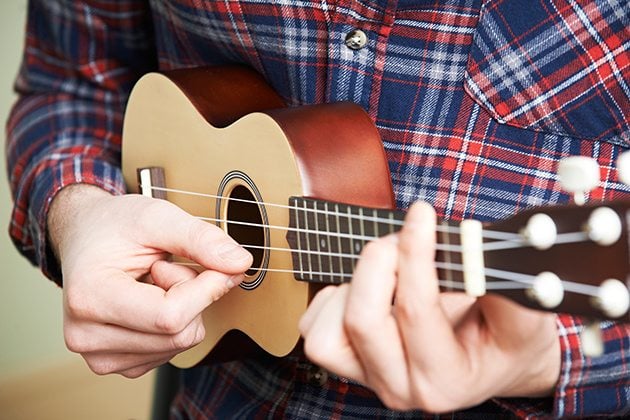
Les bases pour gratter ton ukulélé
Commence par la position de base de la main, qui est un poing souple. Tu grattes avec l’index de ta main droite, ongle vers le bas. Sur le coup vers le bas, ce doit être ton ongle qui touche les cordes. Sur le coup vers le haut, c’est la pulpe du bout du même doigt. Un point important : sers-toi de ton poignet plutôt que de toute ta main. Bouger la main entière fatigue très vite.
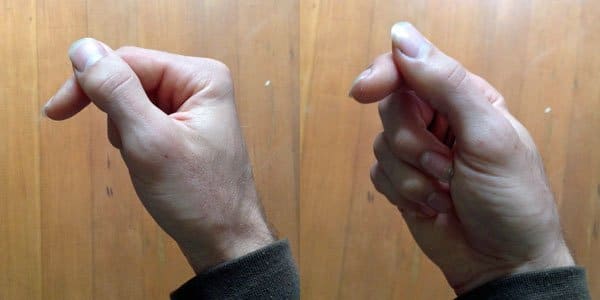
Quand j’ai commencé l’ukulélé, je m’y prenais autrement. Je collais le bout du pouce et celui de l’index comme si je tenais un médiator. Je grattais vers le bas avec l’ongle de l’index et vers le haut avec le bout du pouce. C’est peut-être parce que je venais de la guitare, mais au début j’ai trouvé ça plus facile. Il faut aussi t’assurer que tu grattes au bon endroit. Trop près du chevalet ou trop haut sur le manche, le son devient terne.
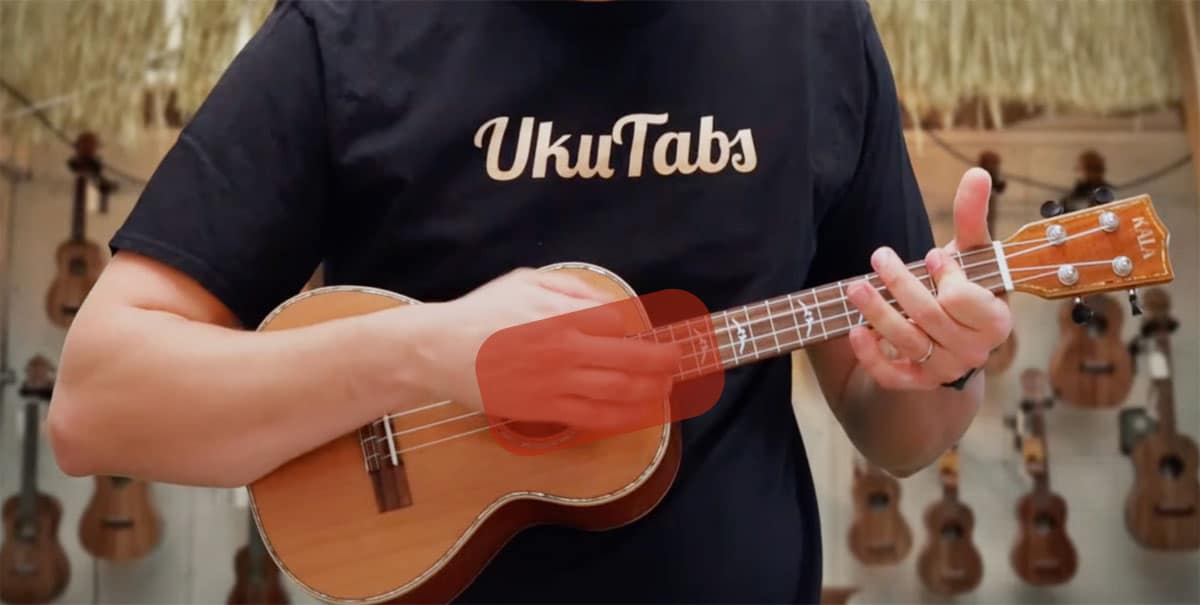
J’ai remarqué que le meilleur endroit pour gratter change d’un instrument à l’autre, mais il se situe en gros à la jonction du manche et de la caisse (la zone rouge ci-dessous).
Entraîne-toi avec l’une ou l’autre méthode en montant et en descendant simplement. Une fois que c’est acquis, passe à la section niveau avancé. Et quand ton strumming tourne tout seul, tu peux commencer à chanter par-dessus. Voici comment chanter et jouer en même temps.
Niveau avancé
Dès que le va-et-vient de base devient confortable, tu peux commencer à dessiner un rythme. Chaque chanson a son propre motif de strumming, et tu en construis un en gardant exactement le même mouvement régulier de haut en bas, mais en évitant les cordes sur certains coups. Essaie par exemple bas, haut, rien, bas : ta main bouge en permanence, mais elle ne touche les cordes que sur les coups que tu veux entendre. Travaille lentement, idéalement avec un métronome autour de 60 battements par minute. N’accélère qu’une fois le motif bien régulier. C’est le fait de garder la main en mouvement sur les coups sautés qui tient tout ton rythme en place.
La notation du strumming
Les motifs de strumming s’écrivent sous forme d’une courte ligne de lettres qui indique dans quel sens ta main bouge sur chaque temps. Je ne publie pas le strumming exact d’une chanson protégée par le droit d’auteur, mais les motifs généraux et la notation ci-dessous fonctionnent sur des milliers d’entre elles. Voici ce que veut dire chaque symbole.
- d : coup vers le bas
- u : coup vers le haut
- – : pause ou coup raté, c’est-à-dire que tu bouges la main vers le haut ou vers le bas sans toucher les cordes. C’est ce qui donne le placement rythmique des coups joués.
- x : un chnk. Tu grattes vers le bas et tu accompagnes le mouvement pour que le dessous de ta main vienne se poser sur les cordes, ce qui produit un son de « chnk ».
- (d) ou (u) : un coup étouffé vers le bas ou vers le haut. Tu grattes normalement, mais les doigts de ta main sur le manche reposent sur les cordes pour les empêcher de résonner. Ça sonne comme un chnk, sauf que tu peux le faire dans les deux sens.
- D ou U : une lettre majuscule veut dire que le coup est accentué, alors envoie-le un peu plus franchement.
Les motifs de strumming
| # | Motif | Idéal pour |
|---|---|---|
| Motifs pour débuter | ||
| 1 | d d d d | Le tout premier strumming (que des coups vers le bas) |
| 2 | d u d u d u d u | Bas et haut sur chaque temps |
| Mesure à 4/4 | ||
| 3 | d – d u – u d – | Le 4/4 qu’on croise partout |
| 4 | d – d u – u d u | Le classique island strum |
| 5 | d – d – d u d u | Un 4/4 qui pousse |
| 6 | d – d u d u d u | Un 4/4 chargé et enlevé |
| Demi-mesure (l’accord change deux fois par mesure) | ||
| 7 | d – d u | Changements d’accords rapides |
| 8 | d u x u | Demi-mesure avec un chnk |
| Deux mesures (changements d’accords lents) | ||
| 9 | d – d u – u d u ×2 | Quand l’accord change toutes les deux mesures |
| Accentuation | ||
| 10 | d u d U d u d U | Accent sur les coups vers le haut |
| 11 | d u x u d u x u | Funky et percussif |
| Reggae | ||
| 12 | – d – d – d – d | Sur les contretemps |
| 13 | – – d u – – d – | Reggae syncopé |
| Mesure à 3/4, la valse | ||
| 14 | d – d u d – | Chansons à trois temps |
| 15 | d – d u d u | Chansons à trois temps, en plus chargé |
| Mesure à 6/8 | ||
| 16 | d – – d – u | Un balancement de berceuse |
| 17 | d – u d – u | Un 6/8 qui coule |
| Un seul coup par mesure | ||
| 18 | d – – – | Ballades lentes, on laisse sonner |
Il n’existe pas un seul motif de strumming correct pour une chanson comme il existe un accord correct. Beaucoup de motifs peuvent coller, et savoir en choisir un à l’oreille est une compétence à part entière. Le tableau ci-dessus liste les plus courants, du plus simple au plus complexe. Chaque motif ci-dessous montre ses flèches et dispose d’un bouton de lecture. La plupart ont aussi un extrait enregistré. Tout nouveau ? Commence par rendre les deux motifs de départ bien réguliers, avant tout le reste. Teste-en quelques-uns sur ta chanson, garde celui qui te paraît juste et, quand tu seras à l’aise, tu pourras inventer les tiens.
Motifs pour débuter
Tu n’as encore jamais gratté ? Rends ces deux-là bien réguliers d’abord, puis passe aux motifs suivants.
Motif 1 : que des coups vers le bas (d d d d)
Le tout premier strumming : un coup vers le bas sur chaque temps. Tout est dans la régularité, alors compte « un, deux, trois, quatre » à voix haute pendant que tu joues.
Des chansons qui l’utilisent sur UkuTabs
Motif 2 : croches bas-haut (d u d u d u d u)
Ajoute un coup vers le haut entre chaque coup vers le bas, pour que ta main fasse bas-haut en continu. C’est la fondation sur laquelle presque tous les motifs ci-dessous sont construits.
Des chansons qui l’utilisent sur UkuTabs
Les motifs de strumming en 4/4
La mesure la plus courante. Si tu peux compter « un, deux, trois, quatre » sur une chanson et que ça tombe juste, essaie ceux-là.
Motif 3 : le 4/4 universel (d – d u – u d –)
Il saute le troisième coup vers le bas, ce qui crée une petite respiration syncopée. Simple, mais on le retrouve absolument partout, d’où son nom.
Des chansons qui l’utilisent sur UkuTabs
- Glen Hansard and Markéta Irglová – Falling Slowly
- The Muppets – Rainbow Connection
- Ben E. King – Stand By Me
Motif 4 : l’island strum (d – d u – u d u)
Le classique island strum : le motif 3 avec un coup vers le haut en plus à la fin. La valeur sûre pour un nombre énorme de chansons, et de loin le motif le plus utilisé sur UkuTabs.
Des chansons qui l’utilisent sur UkuTabs
Motif 5 : le 4/4 qui pousse (d – d – d u d u)
Une sensation régulière qui pousse en avant, avec une seconde moitié de mesure plus chargée.
Des chansons qui l’utilisent sur UkuTabs
Motif 6 : le 4/4 chargé et enlevé (d – d u d u d u)
Un va-et-vient presque continu une fois lancé, ce qui convient aux chansons rapides et enlevées.
Des chansons qui l’utilisent sur UkuTabs
Les motifs en demi-mesure
Pour les chansons où l’accord change deux fois par mesure.
Motif 7 : la demi-mesure (d – d u)
Un strumming court sur une demi-mesure, pour les chansons où l’accord change vite. Tu le joues deux fois par mesure, une fois pour chaque accord.
Des chansons qui l’utilisent sur UkuTabs
- Halsey – Without Me
- Melanie Martinez – Tag, You’re It
- Trevor Daniel – Past Life (feat. Selena Gomez)
Motif 8 : la demi-mesure avec chnk (d u x u)
Un strumming en demi-mesure avec un chnk (le x) pour un rendu percussif et légèrement funky.
Des chansons qui l’utilisent sur UkuTabs
Le motif sur deux mesures
Pour les chansons où les accords changent lentement. Celui-ci étale un seul motif sur deux mesures.
Motif 9 : deux mesures tout en souplesse (d – d u – u d u, ×2)
L’island strum étiré sur deux mesures au lieu d’une, donc chaque accord dure deux fois plus longtemps. Pratique pour les ballades lentes où les accords bougent à peine.
Celui-ci relève plus de la mise en forme que du motif à part entière, donc aucune chanson sur UkuTabs n’y est associée. Prends n’importe quelle chanson lente qui utilise le motif 4 et donne deux mesures à chaque accord au lieu d’une.
L’accentuation
Les mêmes coups, mais tu appuies plus fort sur certains temps pour obtenir un autre groove. Un U majuscule, c’est un coup vers le haut plus appuyé.
Motif 10 : accent sur les coups vers le haut (d u d U d u d U)
Il s’appuie sur les coups vers le haut pour un côté rebondissant et léger, parfait quand tout le monde chante ensemble. Le U majuscule, c’est là que tu envoies.
Des chansons qui l’utilisent sur UkuTabs
- The Foundations – Build Me Up Buttercup
- Neil Diamond – Sweet Caroline
- American Authors – Best Day of My Life
Motif 11 : funky et percussif (d u x u d u x u)
Le groove à chnk du motif 8 étalé sur deux mesures, pour un rendu funky et percussif. Ça colle à tout ce qui repose sur une partie rythmique bien serrée.
Des chansons qui l’utilisent sur UkuTabs
Les strummings reggae
Le reggae accentue les contretemps plutôt que le « un ». Un tiret veut dire que tu sautes ce coup en gardant la main en mouvement.
Motif 12 : le reggae sur les contretemps (– d – d – d – d)
Du pur contretemps : tu ne grattes que sur le « et » de chaque temps, et c’est la base du feeling reggae.
Des chansons qui l’utilisent sur UkuTabs
Motif 13 : le reggae syncopé (– – d u – – d –)
Un strumming reggae syncopé qui accentue le deux et le quatre. Courant dans le reggaeton et la pop latine autant que dans le reggae lui-même.
Des chansons qui l’utilisent sur UkuTabs
La mesure à 3/4
Pour les chansons qui se comptent en trois plutôt qu’en quatre.
Motif 14 : la valse (d – d u d –)
Un strumming simple en 3/4, pour les chansons que tu comptes en trois.
Des chansons qui l’utilisent sur UkuTabs
Motif 15 : la valse chargée (d – d u d u)
Un strumming en 3/4 plus chargé, avec davantage de coups vers le haut.
Des chansons qui l’utilisent sur UkuTabs
- The Beatles – Lucy in the Sky With Diamonds
- Édith Piaf – La Foule
- Bo Burnham – Welcome To The Internet
La mesure à 6/8
Certaines chansons se comptent en six plutôt qu’en quatre, avec un balancement qui roule en dessous. Compte « un deux trois quatre cinq six » de façon régulière et appuie sur le un et sur le quatre. Ces deux motifs s’écrivent sur les six temps plutôt qu’en mesures de quatre.
Motif 16 : le balancement en 6/8 (d – – d – u)
Deux coups par mesure avec une relance sur le dernier temps, ce qui donne aux chansons en 6/8 leur balancement de berceuse. C’est celui à sortir dès qu’une ballade refuse de rentrer en quatre.
Des chansons qui l’utilisent sur UkuTabs
- Twenty One Pilots – Can’t Help Falling In Love
- Leonard Cohen – Hallelujah
- Hozier – Take Me To Church
Motif 17 : le 6/8 qui coule (d – u d – u)
Le même comptage en six, mais avec un coup vers le haut qui referme chaque moitié, donc ça coule au lieu de balancer. Bien pour les chansons qui doivent rester en mouvement sous une voix lente.
Des chansons qui l’utilisent sur UkuTabs
Un seul coup par mesure
Parfois la bonne réponse, c’est de presque ne pas gratter du tout. Sur les chansons lentes et aérées, un seul coup par accord laisse de la place à la voix. En ajouter davantage ne fait que gêner.
Motif 18 : la ballade, un coup par mesure (d – – –)
Un coup vers le bas par mesure, qu’on laisse sonner. Compte les trois autres temps dans ta tête et laisse l’accord respirer. Ça n’a l’air de rien tant que tu ne l’as pas essayé sous une voix lente. Là, ça sonne exactement juste.
Des chansons qui l’utilisent sur UkuTabs
- Billie Eilish – Happier Than Ever
- Harry Styles – Sign Of The Times
- Billie Eilish – Lovely (feat. Khalid)
Questions fréquentes sur le strumming
Quel est le motif de strumming le plus facile à l’ukulélé ?
Le plus simple, c’est un coup vers le bas sur chaque temps, le strumming « que des coups vers le bas » (le motif 1 ci-dessus). Il construit ton sens du rythme et fonctionne sur les chansons lentes ou pour débutants. Quand c’est bien régulier, ajoute un coup vers le haut entre chaque coup vers le bas pour obtenir le strumming bas-haut.
Comment joue-t-on l’island strum ?
C’est le strumming le plus populaire et le plus polyvalent à l’uke. Avec les symboles ci-dessus, le motif s’écrit d – d u – u d u, ce que tu peux dire à voix haute : « bas, bas-haut, haut-bas-haut ». C’est le motif 4 ci-dessus, avec les flèches et un extrait que tu peux écouter.
Comment placer ma main de strumming ?
Fais un poing souple avec ta main de strumming et tiens-la devant le milieu de ta poitrine, pointée vers ton épaule opposée. Gratte depuis le poignet et laisse ton pouce stabiliser ton doigt pour un peu plus de maintien.
À quel endroit faut-il gratter l’ukulélé ?
Si tu grattes trop près du chevalet, le son devient métallique et les cordes n’ont presque aucune souplesse. Sur les sopranos et les concerts, la zone idéale se trouve à peu près à la jonction du manche et de la caisse. Sur les ténors, elle se situe un peu plus près du chevalet.
Quelle est la bonne technique de strumming ?
Sers-toi de ton poignet plutôt que de tout ton bras, sinon tu te fatigueras vite. À la descente, touche les cordes avec ton ongle. À la remontée, avec la pulpe du bout du même doigt.
Comment savoir quel motif de strumming utilise une chanson ?
Repère d’abord les temps forts et compte avec la chanson, puis cherche si les trous tombent sur le temps ou sur le « et » entre deux. La plupart des chansons pop en 4/4 collent au motif 3 ou au motif 4, alors essaie ceux-là avant tout le reste. C’est exactement pour ça que les pages de chansons sur UkuTabs proposent un strumming.
C’est quoi un strumming swing ou shuffle ?
En rythme swing, le coup vers le bas dure environ deux fois plus longtemps que le coup vers le haut, ce qui donne ce côté détendu et rebondissant qu’on entend beaucoup dans la musique hawaïenne, le jazz et le blues. Ça rend un simple va-et-vient bien plus intéressant.
C’est quoi le chunking ?
Le chunking ajoute une frappe percussive à ton strumming. Pendant que tu descends, viens frapper légèrement les cordes avec le tranchant ou le dessous de ta main pour qu’elles claquent au lieu de résonner. On parle parfois de strumming étouffé, et c’est le x de la notation ci-dessus.
C’est quoi un coup mort, un dead strum ?
Un dead strum est un autre clic percussif, mais produit cette fois par ta main sur le manche. Tu poses les doigts légèrement en travers de toutes les cordes pour qu’elles ne résonnent pas, puis tu grattes, ce qui donne un « tchak » bien étouffé.
Faut-il apprendre tous ces motifs de strumming ?
Non. Trois à cinq motifs polyvalents, l’island strum plus deux ou trois autres, te permettent de jouer presque n’importe quelle chanson. Tu en ajouteras d’autres seulement quand une chanson précise le demandera.
Maintenant, gratte sur une vraie chanson
Choisis une chanson que tu connais, lance l’island strum et garde la main en mouvement, même pendant les changements d’accords. Count On Me est sans doute l’endroit le plus accueillant pour commencer, et sa propre page propose exactement ce strumming. Il y en a des milliers d’autres dans la liste des chansons d’ukulélé faciles. Retrouve les positions dans la bibliothèque d’accords gratuite et, quand tu te sens prêt, le guide du fingerpicking est la suite logique. N’hésite pas à me contacter dès que tu veux plus d’infos sur le strumming.
Really helpful. I find strumming the hardest thing playing the uke
jk, but this was super helpful, Thanks!
I thought that the chords and moving my fingers would be the hardest thing for me but once you get that down it becomes muscle memory. Strumming is the hardest thing about the ukulele definitely
i am still having some trouble strumming up, i don’t know how to position my hand.
how to do the chnk
what about this / ?
Thank you! I was unsure on how to strum before but this was really helpful <3
Does anyone know any good song that use the hawaiian strum…Ive been wanting to practice that
Waww! finally 🙂 since I started learning ukulele (without any background in music) I have being jumping from one tutorial to the other and getting frustrated because of the lack of strumming instructions. This guide helped me greatly. Thanks a lot!
Thank you so much! These Strumming patterns helped a lot
I’ve been playing ukulele for around 3 years now and I have a really odd strumming pattern. I use my entire hand, so for a down I hit it with all of my nails and and for an up i hit the upper skin of my thumb and slide onto the nail.
I actually don’t know if that’s okay or not, but it works nonetheless.
I’m so glad I found this. Thanks especially for the little audio clips of the strumms.
TQVM fir this informative ibformation. 🙂
how do i sign-up for newsletter?
Really helpful. Thanks!
How do I fingerpick 😭
How do you do d u u d d?
Just use Middle finger if comfortable and do simple and common pattern of D D U U D U used in most ukulele songs
the e chord is still kind of hard for me tho
i fond struming the hardist