
Reverse chord lookup

Ukulele Chord Namer

Built a chord shape on your ukulele and want to know what it's called? Tap the fretboard below to map out your shape. The UkuTabs chord namer instantly identifies the chord, lists its notes and intervals, flags slash chords when the bass note isn't the root, and shows alternate spellings when more than one name fits. Works across standard high-G, low-G, baritone (DGBE), and D-tuning, mirrors for left-handed players, and plays the chord back so you can confirm by ear.

Tap a shape on the fretboard, see the chord name. Slash-chord aware, all four tunings, lefty mode, audio + share link included.

Features
  • 100% free
  • Click-to-name
  • Slash chords
  • 4 tunings
  • Audio playback
Tuning
Lefthanded

Try a chord shape

Common shapes to load onto the fretboard with one click. Tap a card to set the strings, then click the fretboard to tweak. Each shape is shown as a fret pattern reading left to right in standard tab order: G C E A. The G string sits at the bottom of the horizontal fretboard above and at the left of the portrait mini diagram in the result panel. x = muted, 0 = open.

How chord naming works

A chord's name comes from three things: its root note (the home pitch), the intervals stacked above the root, and whether a different note sits in the bass. The namer looks at the unique pitch classes you played, tries every one as a candidate root, and checks the stack against every chord pattern it knows. Hover any card below for the deeper context.

Triad
3-note chordRoot + 3rd + 5th
7th
4-note chordTriad + seventh on top
Slash
Chord with a bass notelike C/G, Am/E
Same
Same notes, two namese.g. C6 / Am7
Sus
Suspended (sus2 / sus4)Third swapped for 2nd or 4th
Add
Added-note chordTriad + 9 (or 11, 13)
dim
DiminishedStack of minor thirds
aug
AugmentedTriad with a raised 5th
5
Power chordRoot + 5th only
Inv
InversionSame chord, different bass
Ext
Extended chord7th + 9, 11, or 13
No matchNot every set has a name

How to read a ukulele chord diagram

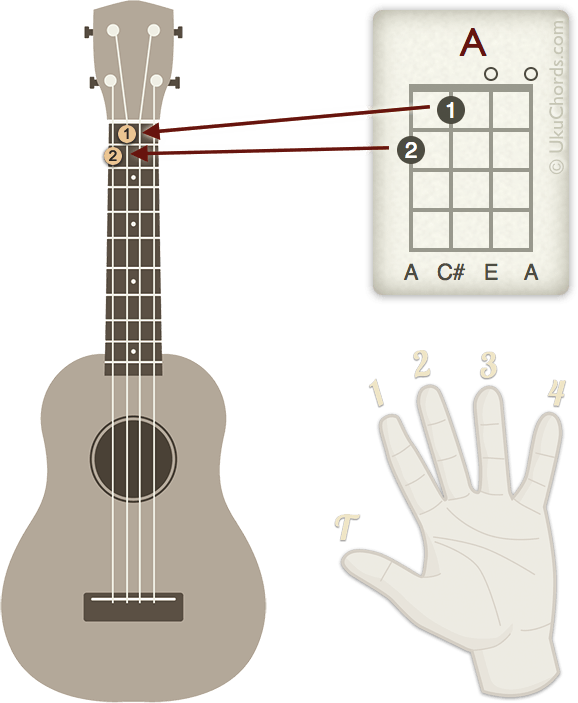
Annotated ukulele chord chart showing finger positions for an A major chord

A ukulele chord diagram is a top-down picture of the first four or five frets of the neck. The four vertical lines represent the four strings. In standard tuning, reading left to right, those are G, C, E, and A. The horizontal lines are the frets, and the thick bar across the top is the nut, the piece of bone or plastic that separates the open strings from the fretted positions.

Dots show where to press your fingers, and the number inside each dot tells you which finger to use: 1 for index, 2 for middle, 3 for ring, and 4 for pinky. A hollow circle above a string means play that string open with no finger touching it. An × means mute the string or skip it entirely when you strum.

If a number appears next to the diagram (for example 5fr), the diagram is shifted up the neck and the top fret shown is actually the fifth fret rather than the first. That's how higher-position and barre chords get drawn without forcing a long, thin diagram.

The example pictured here is an A major chord. Press the G string at the second fret with your middle finger and the C string at the first fret with your index finger. The little o symbols on the E and A strings tell you to let those ring open. For a longer walkthrough with audio, see the how to read ukulele chord diagrams guide.

Do not sell my data